Written by Trivender Singh
Co-Founder at TechniqCo | GEO & AEO Expert specializing in Generative Engine Optimization, Answer Engine Optimization, AI Search Visibility, Technical SEO & Business Growth Scaling.
ChatGPT Ads represent the biggest evolution in digital advertising in India since the launch of mobile search. Rather than bidding on isolated keywords or interrupting social media scrolling, brands can place sponsored recommendation cards, contextual citations, and solution suggestions directly inside multi-turn problem-solving conversations. For Indian enterprises in B2B SaaS, luxury real estate, EdTech, fintech, and professional services, conversational ads provide a direct bridge to high-intent decision-makers before traditional search competition saturates the ecosystem.
For more than two decades, digital marketing budgets in India have been split between two dominant forces: Google Search for capturing intent, and Meta for driving social demand. Yet every marketing leader in India knows the painful reality of 2026: Google CPCs in commercial categories have doubled, while customer acquisition costs on Meta continue to climb due to audience fatigue and tracking friction.
The introduction of advertising within ChatGPT opens an entirely new category: Conversational Advertising. India represents one of OpenAI’s largest and most engaged user bases on the planet. From startup founders in Bengaluru and corporate executives in Gurgaon to students and professionals across Delhi NCR and Mumbai, hundreds of millions of high-value decisions are researched inside ChatGPT every single month.
For business owners and marketing executives, understanding how this platform operates is not optional. It is the beginning of a land grab that will reward early movers with unprecedented conversion efficiency.
The Big Shift: Why Conversational Ads Outperform Keywords
Traditional search engines operate on a fragmented keyword model. A user enters a short query such as “commercial property Gurgaon” or “best billing software India” and receives a list of blue links, sponsored text snippets, and map listings. The search engine knows very little about the specific business context behind the query.
ChatGPT interactions look entirely different. Users do not type isolated keywords. They paste in entire business scenarios, financial parameters, and strategic dilemmas. A typical prompt might be forty words long:
“I run a mid-sized logistics firm in Pune handling cold-storage pharmaceuticals. We need a warehouse management system that integrates with SAP and tracks temperature fluctuations in real time. Our implementation budget is 15 to 25 lakh rupees. What software matches our requirements?”
Advertising inside that conversation is fundamentally different from buying a keyword on Google. The AI understands the industry, the city, the budget, and the technical integration before serving a sponsored recommendation. When an ad appears within that answer, it arrives not as an unwanted distraction, but as a tailored, verified solution to an urgent corporate need.
How ChatGPT Ad Units Work in Practice
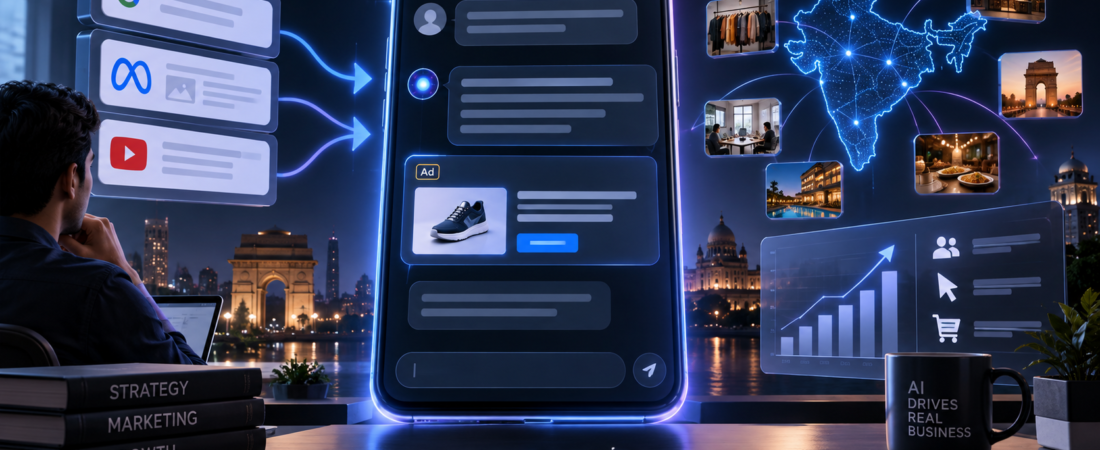
OpenAI has designed its advertising experience to preserve user trust while giving commercial sponsors premier placement. Rather than displaying flashing banners or intrusive video pop-ups, ChatGPT utilizes three core conversational ad formats:
- Contextual Sponsored Cards: Clean, interactive cards embedded directly below or within the AI answer stream. These cards display the company name, a clear “Sponsored” indicator, a concise summary of the offering, and a direct action button linking to a dedicated landing page.
- Sponsored Citation Badges: When the AI compiles a list of recommended vendors or tools, sponsored partners receive enhanced citation tags with verified badges and instant link previews.
- Prompt-Triggered Follow-Up Suggestions: Interactive prompt pills that invite the user to explore the sponsor’s product in the next conversational turn (for example: “Would you like to compare pricing for Vendor X?”).
Head-to-Head Comparison: Google vs. Meta vs. ChatGPT Ads
To allocate your quarterly marketing spend intelligently, leadership teams must understand how conversational AI advertising stacks up against traditional search and paid social.
| Dimension | Google Search Ads | Meta Ads | ChatGPT Conversational Ads |
|---|---|---|---|
| Targeting Basis | Keyword match and location | Demographics and browsing habits | Deep multi-turn conversational intent |
| User Mindset | Evaluating individual links | Passive entertainment scrolling | Active, high-focus problem solving |
| Ad Placement | Top of SERP above organic links | Interspersed in feed, Reels, and Stories | Integrated directly within AI response stream |
| Ad Clutter | High (4 ads plus shopping carousel) | Very High (every third post is an ad) | Extremely Low (1 sponsored card per session) |
| Conversion Quality | Moderate to High | Low to Moderate | Exceptionally High |
The 5 Indian Sectors Poised for Massive ROI
While every business will eventually explore conversational advertising, five sectors in India have the highest commercial incentive to move immediately:
1. B2B SaaS and Enterprise Technology
India’s SaaS founders and software vendors battle brutal competition on Google Ads, where keywords like “CRM software” or “payroll software India” cost hundreds of rupees per click. On ChatGPT, tech leaders, CTOs, and product managers are actively asking the AI to compare software architectures, API documentation, and pricing tiers. Intercepting a decision-maker during an active software evaluation dialogue yields phenomenal sales pipeline quality.
2. Premium and Commercial Real Estate
In high-velocity real estate corridors like Gurgaon Golf Course Road, Dwarka Expressway, Bandra Kurla Complex in Mumbai, and North Bengaluru, property buyers use ChatGPT to analyze infrastructure projects, builder delivery track records, and expected rental yields. Placing a verified sponsored project card directly into those investment discussions connects developers with qualified, high-net-worth buyers.
3. Higher Education, Study Abroad, and Executive Upskilling
Indian students and their parents spend months researching universities, overseas immigration rules, and executive MBA programs inside AI assistants. Educational institutions that sponsor contextual answer cards can capture prospective candidates at the exact moment they compare course curriculums and tuition fee structures.
4. Fintech, Corporate Banking, and Wealth Management
From SME working capital loans and GST invoice discounting to personal mutual fund portfolio construction, financial queries represent huge search volume in India. Conversational ads allow financial institutions and wealth advisory firms to offer relevant credit or investment tools right when users ask how to solve a cash-flow dilemma.
5. High-Ticket Professional Services
Corporate law practices, management consulting firms, tax consultants, and advanced digital growth agencies like TechniqCo benefit massively. When founders ask AI who can handle their technical SEO, corporate restructuring, or international trademarking, sponsored recommendations deliver unmatched authority.
Projected Ad Costs and Bidding Dynamics in India
In the early rollout stages in India, conversational ad inventory operates on an auction-based model with notable first-mover price advantages:
- Cost Per Dialogue (CPD) and Premium CPC: Rather than charging purely on passive impressions, conversational platforms prioritize engagement metrics such as click-throughs and follow-up prompt triggers.
- The First-Mover Arbitrage: Just as early advertisers on Facebook in 2012 and Google AdWords in 2004 enjoyed tiny acquisition costs, early bidders on ChatGPT in India will face minimal competition in their category, securing high-intent leads at a fraction of future market rates.
- Quality Score Driven by Relevance: OpenAI places strict limits on ad frequency to protect user experience. If a sponsored card does not directly satisfy the user’s conversational intent, the system will depress its delivery rate regardless of bid amount.
What Indian Leadership Teams Must Prepare This Quarter
Waiting for conversational ads to become mainstream before preparing your marketing infrastructure is a recipe for expensive catch-up later. Here is what business owners and CMOs must do right now:
- Audit Your Brand Knowledge Graph: Before spending a single rupee on conversational ads, ensure the AI knows who you are organically. If an AI recommends your product in a sponsored card but gives a vague or inaccurate answer when the user asks a follow-up question, your ad spend is wasted.
- Build Conversational Landing Pages: Traffic arriving from an AI conversation expects a direct, frictionless answer. Replace generic 20-field lead forms with interactive calculators, instant WhatsApp chat options, and concise comparison matrices.
- Establish Clear Multi-Channel Attribution: Prepare your analytics to track conversational referral paths and direct brand search spikes resulting from AI visibility.
- Partner with an AI-Native Growth Agency: Work with an agency that understands both paid media auctions and organic Generative Engine Optimization (GEO) to ensure your paid and organic AI strategies reinforce each other.
Coming Next: Part 2 of Our Series
In Part 2 of this series, we go deep into the tactical execution: “The ChatGPT Ads Playbook for Indian Brands: Tracking, Attribution, and the GEO Formula.” We will examine cookieless conversion tracking, how to build high-converting conversational landing pages, and the exact step-by-step checklist to launch your first pilot campaign. Stay tuned.
Frequently Asked Questions
Are ChatGPT Ads visible to paying ChatGPT Plus and Enterprise subscribers in India?
OpenAI has focused its sponsored ad units primarily on the free tier and search-enabled sessions. Enterprise and Team subscription tiers remain ad-free to uphold strict enterprise privacy contracts. However, the free tier in India represents tens of millions of active monthly users, encompassing startup founders, agency leads, professionals, and students who make significant purchasing decisions.
How do ChatGPT Ads handle user privacy and data tracking in India?
Conversational advertising relies on contextual intent rather than invasive third-party tracking cookies or personal identity harvesting. The ad auction analyzes the parameters of the active dialogue to determine commercial relevance. Advertisers receive aggregated campaign performance data without compromising user conversation privacy or violating India’s Digital Personal Data Protection Act.
Can my competitors bid on my brand name inside ChatGPT?
Unlike Google Search Ads, where competitors routinely bid on your trademarked brand keywords, conversational platforms enforce strict relevance and truthfulness standards. If a user asks specifically about your brand, serving an unrelated competitor ad violates the core helpfulness principle of the assistant. However, competitors can bid to appear in general comparative prompts such as “alternatives to Company X,” which makes organic GEO defense critical.
How does TechniqCo help businesses prepare for ChatGPT advertising?
TechniqCo provides end-to-end conversational AI marketing solutions. We optimize your brand’s organic entity signals through Generative Engine Optimization (GEO) and Answer Engine Optimization (AEO), while designing high-converting conversational ad creative and targeted campaign structures to capture qualified leads across India.
Ready to Pioneer Conversational AI Advertising for Your Business?
Do not wait until your competitors saturate conversational advertising. TechniqCo helps forward-thinking brands across India build early-mover advantage through integrated AI search optimization, Generative Engine Optimization, and conversational paid media strategies. Book a confidential strategy session with our founding team today.
Schedule an AI Advertising Strategy Session →Related posts:
 The Advanced AI Prompt Playbook: ChatGPT Prompts for SEO, GEO, and AEO in 2026
 How to Get Your Brand Cited in ChatGPT Search, Perplexity & Google Gemini in 2026: The Complete GEO Blueprint
 ChatGPT vs. Claude for SEO in 2026: Which AI Wins at Each Stage of the Workflow?
 Google Maps in the AI Era: How Gemini & Multimodal Search Are Changing Local 3-Pack Rankings in 2026
 Zero-Click Search 2026: How Businesses Capture Customers Without Website Traffic
 Beauty Salon Local SEO 2026: How Beauty Parlors Fill Weekly Appointment Slots Without Ad Spend