Written by Trivender Singh
Co-Founder at TechniqCo | GEO & AEO Expert specializing in Generative Engine Optimization, Answer Engine Optimization, AI Search Visibility, Technical SEO & Business Growth Scaling.
What is Generative Engine Optimization (GEO) and how do AI search engines cite brands?
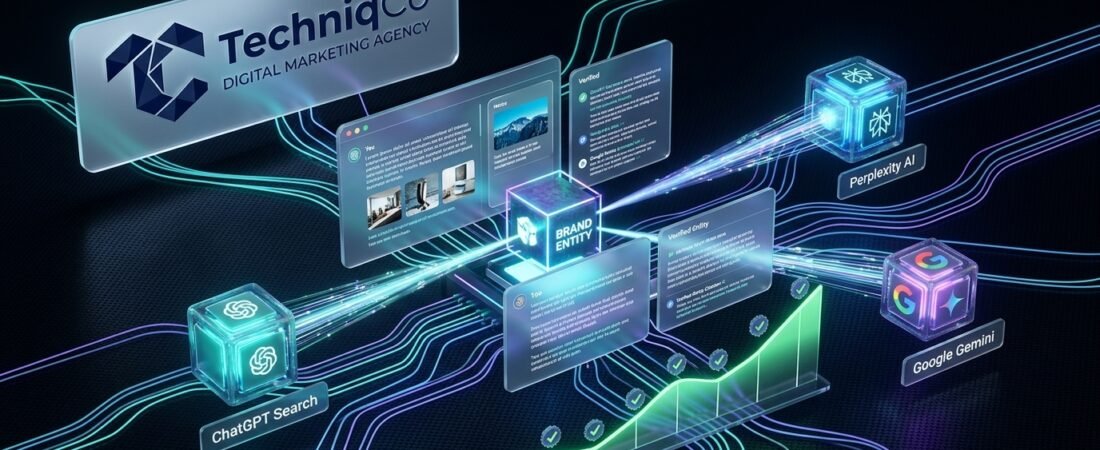
Generative Engine Optimization (GEO) is the practice of structuring digital content, entity relationships, and brand data so that generative AI engines such as ChatGPT Search, Perplexity AI, Google Gemini, and Microsoft Copilot select and cite your business in direct conversational answers. AI engines retrieve information through Retrieval-Augmented Generation (RAG) by evaluating digital entity authority, factual consensus across independent authoritative sources, structured schema markup, and semantically clear quotation blocks.
The transition from traditional ten blue links to conversational answer engines represents the most significant shift in digital discovery since the invention of the web search engine. When a prospective client asks ChatGPT, “What is the best B2B marketing agency for tech startups in India?” or prompts Perplexity with “Compare top enterprise travel booking platforms,” the AI does not display an ad auction or a list of ten page links. It generates a synthesized, definitive answer and cites two to four trusted sources as verification.
If your brand is not among those citations, you are completely invisible to a rapidly growing segment of high-intent buyers who no longer click through traditional search result pages. This guide provides the complete, field-tested Generative Engine Optimization (GEO) blueprint to ensure your brand is recognized, trusted, and cited by AI engines in 2026.
Part 1: The Evolution: SEO vs. AEO vs. GEO
Understanding how AI search engines function requires distinguishing between the three major eras of search engine optimization:
| Search Dimension | Traditional SEO | AEO (Answer Engine Optimization) | GEO (Generative Engine Optimization) |
|---|---|---|---|
| Primary Target | Google Search Algorithms, Bing Crawlers | Google Featured Snippets, Voice Assistants | Large Language Models (ChatGPT, Perplexity, Gemini, Claude) |
| Content Objective | Rank for specific target keywords | Provide direct 40 to 60 word concise answers | Build entity authority, semantic consensus, and multi-source proof |
| Retrieval Mechanism | Keyword matching, PageRank, backlinks | Structured schema data, FAQ headers, list structures | Vector search embeddings, RAG pipelines, Knowledge Graph nodes |
| Success Metric | SERP Rank (#1 to #10), Organic Impressions, Clicks | Position Zero Featured Snippet Win Rate | AI Citation Frequency, Brand Share of Voice (SoV), Referral Traffic |
Part 2: How AI Search Engines Choose What to Cite
Generative AI engines do not guess which brands to recommend. They operate through sophisticated Retrieval-Augmented Generation (RAG) systems that follow a strict evaluation pipeline:
- Query Decomposition & Intent Parsing: When a user submits a prompt, the AI decomposes the question into sub-queries. A prompt like “Find the top conversion rate optimization agencies for Shopify stores” generates background searches for reviews, case studies, verified client rosters, and industry benchmarks.
- Vector Embeddings & Semantic Retrieval: The AI queries index vectors to find content that matches the conceptual intent of the search rather than just literal keyword strings.
- Cross-Source Consensus Verification: Large Language Models are heavily trained to avoid hallucinations. Before recommending a brand, the engine looks for third-party validation across independent platforms such as Clutch, LinkedIn, Crunchbase, Wikipedia, industry press releases, and reputable trade publications.
- Extractable Quotation Units: The AI extracts structured, self-contained paragraphs that clearly explain why a brand qualifies for the query, embedding footnote citations directly into the answer.
Part 3: The 6-Pillar GEO Implementation Blueprint
1. Entity Authority & Knowledge Graph Grounding
AI models understand the web as a network of interconnected entities (people, organizations, places, concepts) rather than isolated webpages. To become a recognized entity in Google’s Knowledge Graph and LLM training corpora:
- SameAs Linking: Use comprehensive Organization schema that links your website to all verified external profiles (Wikidata, Crunchbase, LinkedIn, official Google Business Profile).
- Consistent Name, Address, Positioning: Ensure your core value proposition and brand description are identical across every digital touchpoint.
- Author Entity Association: Every article must feature an established author entity with verifiable credentials, author schema, and linked professional profiles.
2. Structured Data: Beyond Basic Schema
Standard schema is no longer enough for advanced AI crawlers. Implement deep nested JSON-LD schema linking entities explicitly:
- ItemReviewed & Review Schema: Verifiable customer evaluations with clear author and rating values.
- About & Mentions Entities: Use schema properties (
about,mentions) pointing to canonical Wikipedia or Wikidata URLs to clarify exactly which industry concepts your content covers. - Service & Organization Hierarchy: Explicitly declare your services, geographic service areas, and executive leadership within connected graph nodes.
3. The “Quotable Passage” Formatting Method
AI models extract content in chunks. If your core insights are buried inside long, winding paragraphs, the RAG parser skips them. Structure your content with dedicated quotation blocks:
- Direct Answer Lead: Begin major sections with a 40 to 60 word standalone summary that answers the header query directly.
- Data-Dense Explanations: Include concrete metrics, steps, and technical terminology in clean bulleted lists and markdown tables.
- Contextual Clarity: Avoid vague pronouns like “it”, “they”, or “this tool”. Name the specific platform, technique, or brand entity explicitly in every key insight.
4. Third-Party Consensus & Digital PR Engineering
AI engines place high trust in third-party validation. If your website is the only place on the internet claiming you are an industry leader, the AI will not cite you. Build external consensus through:
- Industry Directories & B2B Review Platforms: Verified listings on platforms like Clutch, G2, Trustpilot, GoodFirms, and Google Business Profile.
- Podcast Interviews & Expert Roundups: Audio transcripts and digital mentions on recognized industry publications.
- Original Research Reports: Publishing proprietary data studies (e.g., industry benchmark reports) that other websites cite and link back to as primary sources.
5. Technical AI Crawler Accessibility
Ensure your server and robots configuration permit next-generation AI retrieval bots. Keep your robots.txt explicitly open to modern search crawlers:
User-agent: OAI-SearchBot
Allow: /

User-agent: PerplexityBot
Allow: /

User-agent: Google-Extended
Allow: /

User-agent: ClaudeBot
Allow: /
Ensure server response times are under 300ms, Core Web Vitals pass all Interaction to Next Paint (INP) benchmarks, and XML sitemaps include clean lastmod date timestamps.
6. Conversational Intent Mapping
Traditional SEO targets short keyword queries (“SEO agency Delhi”). AI search users submit complex conversational prompts (“Which digital marketing agency in Delhi has proven experience scaling B2B SaaS lead generation?”). Create dedicated comparison pages, detailed methodology breakdowns, and problem-solution guides that mirror how real executives prompt AI tools.
Part 4: How to Measure Your Brand’s AI Share of Voice
| Tracking Metric | How to Measure It | Target Benchmark |
|---|---|---|
| Prompt Citation Rate | Test 20 industry purchase-intent prompts monthly across ChatGPT, Perplexity, Gemini | > 40% citation inclusion |
| AI Referral Traffic | Track GA4 referral sources from chatgpt.com, perplexity.ai, android-app://com.google.android.googlequicksearchbox |
15% to 25% monthly growth |
| Knowledge Graph Presence | Check Google Knowledge Panel status and Wikidata entity verification | Verified Knowledge Panel live |
Frequently Asked Questions
Can you pay to get cited in ChatGPT Search or Perplexity?
No. Unlike Google Ads or sponsored links, citations in ChatGPT Search and Perplexity organic responses are generated purely through algorithmic retrieval based on topical authority, verified entity consensus, and semantic relevance. While ad products are emerging on AI platforms, organic AI citations remain strictly merit-based.
How long does it take for GEO optimizations to show results?
For real-time RAG engines like Perplexity AI and ChatGPT Search (with browsing enabled), content changes can trigger citations within 2 to 4 weeks after indexing. For foundational model training sets that update periodically, entity grounding typically solidifies over a 2 to 6 month window.
Does traditional SEO still matter if I focus on GEO?
Yes, absolutely. High-performing GEO is built on top of strong Technical SEO fundamentals. AI search engines use web crawler indexes as their primary retrieval database. If your website has poor crawlability, slow load speeds, or weak backlink authority, the AI’s retrieval pipeline will not discover your content in the first place.
What is the single most common mistake in GEO strategy?
The biggest mistake is optimizing only on your own domain while ignoring external entity consensus. AI models cross-verify claims. If your website claims you are the leading agency in your field but no reputable third-party publications, directories, or industry databases corroborate that fact, the AI treats the claim as unverified and will not cite your business.
Ready to Make Your Brand Visible in AI Search?
At TechniqCo, we specialize in Generative Engine Optimization (GEO), Entity Schema Engineering, and AI Search Visibility across ChatGPT, Perplexity, and Google Gemini. Let’s position your business as the definitive authority in your industry.
Related posts:
 Technical SEO for AI Crawlers 2026: Sitemaps, Schema, and Robots Strategies That Work
 Schema.org Entity Graph Optimization 2026: Building Knowledge Graph E-E-A-T
 The Complete Checklist for SEO, GEO, and AEO: Dominating Search in the AI Era
 The Ultimate Guide to Generative Engine Optimization (GEO): How to Rank in ChatGPT, Gemini, and Claude
 The Ultimate On-Page SEO Checklist 2026: 47 Points to Rank #1 on Google
 Google Maps in the AI Era: How Gemini & Multimodal Search Are Changing Local 3-Pack Rankings in 2026