Written by Trivender Singh
Co-Founder at TechniqCo | GEO & AEO Expert specializing in Generative Engine Optimization, Answer Engine Optimization, AI Search Visibility, Technical SEO & Business Growth Scaling.
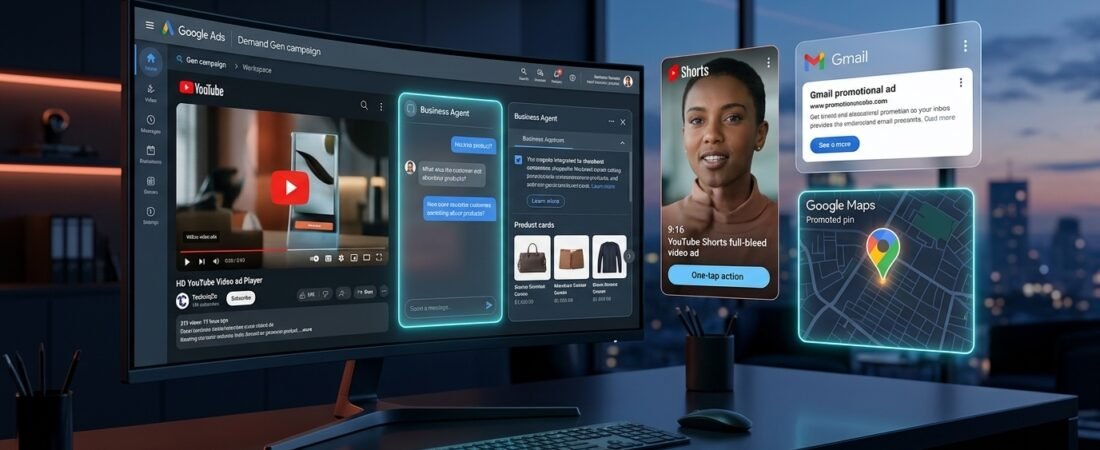
On September 24, 2026, Google officially launched the September Demand Gen Drop 2026, introducing major updates to its visual AI advertising format (as detailed in Google’s official ads announcement). The standout development in Google Demand Gen September 2026 is Business Agent for YouTube Ads, an interactive conversational AI feature that allows viewers to ask real-time product questions directly alongside video ads using connected product feeds. Alongside Business Agent, Google announced single-tap landing page experiences for YouTube Shorts and Gmail, expanded Affiliate Location Extensions with promoted pins on Google Maps, and rolled out AI performance insights in Google Merchant Center to help advertisers scale for fourth-quarter (Q4) and festive shopping.
Google’s September 2026 Demand Gen update introduces new AI-powered and shopping-focused capabilities across Google’s advertising ecosystem. The most notable development is Business Agent for YouTube Ads, alongside new landing experiences for YouTube Shorts and Gmail, Google Maps location features, and Merchant Center AI reporting.
What Is Google’s September 2026 Demand Gen Update?
Google Demand Gen is an AI-powered campaign type designed to build awareness, mid-funnel consideration, and action across Google’s visual surfaces: YouTube, YouTube Shorts, Discover feeds, and Gmail. While Search campaigns capture active intent when users submit search queries, Demand Gen generates demand by serving rich visual media to high-intent audience segments.
Announced in late September 2026 ahead of the global holiday rush and India’s peak festive period, the update aims to shorten the path from initial visual discovery to commercial checkout. By integrating conversational assistants, reducing clicks on mobile devices, and connecting offline locations, Google is making its ad ecosystem substantially more interactive.
Quick Answer Summary Table
| Google Demand Gen Update | What It Means |
|---|---|
| Business Agent for YouTube Ads | Conversational AI assistant answers shopper questions beside video ads using product feeds and website data. |
| YouTube Shorts One-Click Ads | Vertical 9:16 image ads open advertiser landing pages with a single tap for direct mobile navigation. |
| Gmail Image Ads | Streamlined single-tap navigation in Gmail Promotions and Social tabs, delivering faster mobile access. |
| Google Maps Promoted Pins | Affiliate Location Extensions show branded pins in Maps navigation and search for retail networks and dealerships. |
| Merchant Center AI Performance Insights | Analytics dashboard reporting product visibility and share of voice across Google AI search surfaces. |
How Does Google Demand Gen Differ from Search Ads?
While Google Search Ads capture active demand from shoppers typing explicit search queries into Google, Demand Gen campaigns generate consideration across YouTube, Discover, and Gmail by reaching high-intent audiences with rich visual formats before they search.
| Feature | Google Search Ads | Google Demand Gen Campaigns |
|---|---|---|
| Primary Intent | High active intent (user-initiated keyword queries) | Discovery, mid-funnel consideration, visual engagement |
| Core Ad Formats | Text ads, call assets, structured sitelinks | Vertical video (Shorts), full-bleed image cards, interactive carousels |
| Core Placements | Google Search results pages, Search Partner Network | YouTube home, YouTube watch next, YouTube Shorts, Discover feeds, Gmail |
| Primary Bidding Goals | Target CPA, Target ROAS, Maximize Conversions | Maximize Clicks, Target CPA, Target ROAS, Maximize Conversions |
| AI Capabilities | Automated bidding and AI-powered optimization | Automated bidding and creative optimization; Business Agent currently limited to eligible beta participants |
Google Demand Gen vs Performance Max: Key Differences
Many advertisers ask how Demand Gen fits alongside Performance Max (PMax), Google’s other flagship automated campaign type. While both rely heavily on machine learning and automated bidding, they serve distinct strategic roles within an account architecture.
Feature Comparison: Demand Gen vs Performance Max
| Feature | Google Demand Gen | Performance Max (PMax) |
|---|---|---|
| Primary Campaign Objective | Consideration, visual discovery, mid-funnel engagement | Bottom-funnel conversions, total conversion value |
| Available Inventory | YouTube (In-Stream, In-Feed, Shorts), Discover, Gmail | All Google channels: Search, Shopping, YouTube, Display, Discover, Gmail, Maps |
| Search Keyword Auction | Excluded (does not serve on text search queries) | Included (competes directly across Search inventory) |
| Creative Emphasis | Immersive visual storytelling: 9:16 vertical video, Shorts, lifestyle images | Multi-format asset groups: text headlines, descriptions, images, logos, video |
| Channel-Level Control | High visual control: choose video-only, image-only, or multi-format groups | Unified black box: Google’s algorithm decides channel allocation dynamically |
| Audience Targeting Signals | Deterministic Lookalike Segments, custom search intent, first-party data | Audience Signals used purely as algorithmic hints |
| Product Feed Integration | Optional (displays shoppable product cards and enables Business Agent) | Optional/Core (powers Shopping ads and dynamic product listings) |
When to Choose Demand Gen Over Performance Max
- When You Want Creative Control: If your brand relies on polished, high-production visual assets and you want to prevent Google from auto-generating low-quality text or display combinations, Demand Gen keeps ad delivery restricted to premium visual surfaces.
- When Prospecting New Audiences: Demand Gen features dedicated Lookalike Segments based on your customer lists, making it effective for cold audience discovery without bidding on expensive generic search keywords.
- When Running Seasonal or Visual Storytelling Campaigns: For festive launches, new product drops, and brand awareness initiatives, Demand Gen drives immersive engagement across YouTube and Shorts before shoppers enter the active search phase.
Running Demand Gen and Performance Max Together
Demand Gen and Performance Max are not mutually exclusive. The most effective Google Ads strategies run both in parallel: Demand Gen builds mid-funnel consideration and introduces new shoppers to your catalog on YouTube and Discover, while Performance Max and Search capture active search intent and close conversions across Google Search and Shopping.
What Is Google Business Agent for YouTube Ads?
The primary feature introduced in the September 2026 update is Business Agent for YouTube Ads. Google is expanding Business Agent capabilities to YouTube video advertising.
Business Agent is a conversational AI interface that appears directly next to or below video ad creative on YouTube. When a viewer watches a video advertisement featuring products from a connected Merchant Center feed, they can tap to open a conversational drawer without leaving the YouTube video player.
How Does Google Business Agent Work?
Google designs Business Agent to ground conversational responses directly in verified business data sources:
- The Merchant Center Product Feed: SKU-level attributes, variant options, pricing, availability, and delivery terms.
- The Advertiser’s Verified Website: Product specifications, return policies, warranty documentation, and brand FAQ content.
By anchoring responses to verified catalog data and merchant pages, Google aims to minimize ungrounded claims and ensure shoppers receive factual details about products shown in the ad. As the feature remains in beta, advertisers should maintain accurate feed data and monitor shopper interactions as adoption expands.
What Can Shoppers Ask Business Agent?
Shoppers can ask natural-language questions that typically cause hesitation before a purchase. Consider these illustrative examples across major consumer categories:
- Fashion & Apparel: “Does this winter jacket run true to size, and do you have large in navy?” The agent cross-references active stock and sizing charts to confirm availability immediately.
- Consumer Electronics: “Is this wireless charger compatible with iPhone 16 and Samsung Galaxy S25?” The agent reviews technical compatibility notes on the landing page.
- Cosmetics & Skincare: “Is this sunscreen non-comedogenic and suitable for oily skin?” The agent references dermatological claims and ingredient lists from the brand site.
- Home Appliances: “What is the warranty coverage, and does this include free delivery?” The agent reviews the merchant’s shipping policy and warranty guidelines.
(Note: These scenarios are illustrative examples demonstrating how structured feed data answers common shopper questions; actual phrasing depends on the merchant’s uploaded data.)
Who Can Use Business Agent for YouTube Ads?
Google is currently testing Business Agent for YouTube Ads in a limited beta for eligible U.S. retailers running video ads with active product feeds. Advertisers must have an approved Google Merchant Center catalog with accurate pricing and inventory data. Google has not yet announced a timeline for general worldwide availability.
Is Google Business Agent Available in India?
Google’s current YouTube Business Agent beta is limited to eligible U.S. retailers, so it is not currently available to Indian advertisers through that beta. Google has not announced a broader India rollout. However, Indian brands can prepare by auditing their Merchant Center feeds and testing AI performance insights in Google Merchant Center, which is active in India.
How Does Google’s Demand Gen Update Affect YouTube Shorts Ads?
In the September 2026 Demand Gen Drop, Google introduced dedicated enhancements for vertical creative on YouTube Shorts.
What Are the New YouTube Shorts Ad Features?
Google introduced a one-click landing-page experience for eligible image ads on YouTube Shorts. The updated experience allows users to reach the advertiser’s destination page with a single tap.
What Is the 9:16 YouTube Shorts Ad Format?
To qualify for the one-click Shorts experience, advertisers must provide 9:16 vertical full-bleed image creative within their Demand Gen asset groups.
TechniqCo recommends structuring 9:16 visual assets using this 5-point mobile framework:
- Single Proposition: Focus on one clear product benefit or seasonal offer to avoid mobile clutter.
- Visual Hierarchy: Place the hero product in the center and top 60% of the screen.
- Safe-Zone Text: Keep headlines and logos away from the bottom and right edges where YouTube overlays icons and captions.
- Action-Oriented Call to Action: Use high-contrast buttons such as Shop Now or Explore Deals.
- Landing Page Continuity: Ensure the destination URL instantly matches the imagery and price shown in the ad. If producing AI-assisted visual assets, follow rigorous media standards, such as those detailed in our guide on AI video workflows for YouTube.
What Is New for Gmail Demand Gen Ads?
Gmail has long served as a high-intent placement within Google Demand Gen. In the September 2026 update, Google simplified the user path by rolling out single-tap landing page navigation for image ad creatives across the Gmail Promotions and Social tabs.
What Does Google’s 40% Gmail Conversion Figure Mean?
Alongside this release, Google published a specific performance figure regarding Gmail placements:
Official Google Performance Data
“Google reports that advertisers adding Gmail to Demand Gen campaigns saw image creatives achieve an average 40% increase in conversions at the same ROI.”
Source: Google Internal Data, cited in official Google Ads announcement, September 2026. Reported platform benchmark; not a guaranteed performance result for every individual advertiser.
Contextualizing the 40% Statistic
Performance marketers should evaluate this figure in context:
- Reported Platform Data: Google reports that advertisers adding Gmail to Demand Gen campaigns saw image creatives achieve an average 40% increase in conversions at the same ROI.
- No Universal Guarantee: This is Google’s reported internal data and should not be interpreted as a guaranteed result for individual advertisers. Actual performance depends on creative quality, audience relevance, and competitive pricing.
What Are Google Maps Promoted Pins in Demand Gen?
To bridge the gap between digital discovery and brick-and-mortar foot traffic, Google expanded Affiliate Location Extensions into Demand Gen campaigns, allowing promoted location pins to appear within Google Maps.
When users explore or navigate inside Google Maps, eligible Demand Gen campaigns can display branded promoted pins and location cards that highlight nearby retail stores and authorized dealers.
Who Can Use Affiliate Location Extensions?
According to Google Ads Help documentation on location assets, Affiliate Location Extensions are specifically designed for manufacturers, brands, and distributors that sell products through third-party retail chains, supermarket networks, or authorized dealerships rather than brand-owned storefronts.
For example, an electronics manufacturer stocked at national retail stores or a cosmetics label sold through beauty retail chains can use Affiliate Location Extensions to:
- Direct nearby consumers to physical retail stockists carrying their brand.
- Provide driving directions, store hours, and distance markers directly in Google Maps.
- Capture local foot traffic during high-volume shopping weekends and festive seasons.
Google Maps Advertising Best Practices
- Verify Dealer and Retail Chains: Select approved retail chains and dealer networks within Google Ads to ensure accurate location mapping.
- Apply Geo-Targeting Adjustments: Prioritize budgets around high-density retail districts, metropolitan malls, and high-foot-traffic commercial zones.
- Align Creative with Retail Promotions: Match promotional headlines in Demand Gen ads with active in-store retail partner offers.
What Are Merchant Center AI Performance Insights?
On September 16, 2026, Google announced that AI performance insights are now generally available in Google Merchant Center (accessible under Analytics > Products > AI performance).
Organic AI Visibility vs Paid Demand Gen Campaigns
A critical distinction for marketers is that Merchant Center AI performance insights measure organic product discovery, not paid ad clicks.
When shoppers use conversational surfaces such as Google AI Overviews or Google Search AI Mode, Google draws upon organic Merchant Center catalog data to present relevant products. In contrast, Demand Gen campaigns actively serve paid visual creative across YouTube, Discover, and Gmail. Together, they represent complementary pillars of a modern Google strategy: organic visibility in generative answer surfaces, supported by targeted visual advertising to generate consumer consideration.
How Does Google AI Performance Insights Work?
As Google incorporates conversational AI across search results, consumers increasingly ask complex shopping questions (such as “What are the best breathable running shoes for flat feet under $150?”). The AI performance insights tab reports on:
- AI Impressions: How often a brand’s products appear in AI-generated shopping answers and AI Overviews.
- AI Clicks: Referral visits driven from AI-generated shopping responses.
- Top Appearing Products: Which specific SKUs receive the greatest organic visibility in AI search.
- Competitive Share of Voice: How a merchant’s product visibility compares against category competitors across AI surfaces.
Is Merchant Center AI Performance Insights Available in India?
Yes. Google confirmed that AI performance insights are generally available to merchants in Australia, Canada, India, New Zealand, and the United States. Indian retailers and D2C brands can access this reporting immediately to measure their visibility across Google’s generative search experiences.
Does Google AI Performance Insights Track ChatGPT or Perplexity?
No. Google’s AI performance insights track visibility strictly across Google’s own ecosystem (such as AI Overviews and Google Search AI Mode). It does not provide data on third-party conversational engines such as OpenAI ChatGPT Search, Anthropic Claude, or Perplexity Pro. Tracking brand visibility across external answer engines requires broader Generative Engine Optimization (GEO) auditing.
Why Product Feeds Matter for AI-Powered Google Ads
Structured product data is an important source of information for Google’s shopping and advertising systems. If a merchant’s product feed contains missing attributes or outdated inventory, conversational ad tools cannot function accurately.
Structured Product Feed in Merchant Center
                    ↓
Machine Understanding & Grounding
                    ↓
Dynamic Ad & Business Agent Experience
                    ↓
Grounded Product Information for Shoppers
                    ↓
Informed Purchase Consideration
What Product Data Does Google Need?
To improve product visibility and the quality of shopping information available to Google’s systems, merchants should provide complete and accurate product data:
- Titles: Descriptive product titles including brand, model, color, and size (e.g., “Brand Men’s Merino Wool Crewneck – Navy – Size L”).
- Descriptions: Detailed product descriptions covering specifications, materials, and technical attributes.
- Availability: Accurate real-time stock status to prevent promoting unavailable merchandise.
- Price: Up-to-date pricing matching the destination landing page.
- Variants: Item group identifiers linking size, color, and pack alternatives.
- Shipping: Transit times, delivery thresholds, and return policy details.
- Images: High-resolution product images showcasing clean, accurate visuals.
How Should E-commerce Brands Optimize Merchant Center?
E-commerce brands should ensure product feeds are kept synchronized with live website inventory through automated synchronization methods supported by Google Merchant Center, such as the Content API, scheduled feed fetches, or supplemental feeds for seasonal pricing and promotional discounts. Supplying clean, high-resolution imagery from multiple angles also supports visual discovery across Google surfaces, as analyzed in our guide on Google Search Console’s multimodal search reporting.
How to Set Up a Google Demand Gen Campaign: Step-by-Step Guide
Setting up a Demand Gen campaign requires thoughtful asset preparation and audience configuration. Follow this practical 6-step walkthrough based on Google Ads campaign creation guidelines:
Step 1: Create a Campaign and Select Your Goal
- In your Google Ads dashboard, click + New Campaign.
- Select your campaign objective: Sales, Leads, or Website Traffic (or choose Create a campaign without a goal’s guidance for custom bidding control).
- Under Campaign Type, select Demand Gen.
Step 2: Configure Bidding and Budget
- Choose your bidding strategy:
- Maximize Conversions: Best for establishing initial baseline volume.
- Target CPA (Cost Per Acquisition): Recommended once your account has sufficient conversion tracking history.
- Target ROAS (Return on Ad Spend): Ideal for e-commerce stores with variable product pricing and Merchant Center integration.
- Maximize Clicks: Suitable for brand awareness and top-of-funnel traffic generation.
- Set your daily budget. Google recommends allocating a daily budget of at least 5 to 10 times your target CPA to give the bidding algorithm sufficient headroom to optimize.
Step 3: Attach Your Google Merchant Center Product Feed (Optional)
If you sell physical products, check Attach a product feed and select your approved Google Merchant Center catalog. This step unlocks shoppable product carousels beneath video ads and establishes eligibility for conversational Business Agent features.
Step 4: Define Geographic and Device Targeting
- Select your target locations (country, region, or city radius).
- Set language preferences.
- Configure device targeting if you want to emphasize mobile delivery for vertical 9:16 Shorts creative.
Step 5: Build Diversified Asset Groups
To maximize ad relevance across YouTube, Discover, and Gmail, provide a rich mix of creative assets:
- Landscape Video (16:9): 15 to 30 seconds for standard YouTube In-Stream placements.
- Vertical Video (9:16): 10 to 60 seconds optimized for the YouTube Shorts feed.
- Square Video (1:1): Versatile format for mobile Discover and feed placements.
- Full-Bleed Vertical Images (9:16): Essential for eligible one-click landing page ads in Shorts.
- Landscape and Square Images: For Gmail Promotions and Discover cards.
- Text Assets: Up to 5 headlines (40 characters) and up to 5 descriptions (90 characters).
- Call to Action: Select appropriate action buttons such as Shop Now, Learn More, or Order Now.
Step 6: Define Audience Signals and Lookalike Segments
Configure targeted audience signals to guide Google’s machine learning models:
- Custom Search Intent Segments: Add 10 to 15 high-intent Google search terms your target buyers search for.
- First-Party Customer Match Lists: Upload customer email lists and past purchaser data (hashed for privacy).
- Lookalike Segments: Create 2% to 5% lookalike audiences based on your highest-value customers to prospect new potential buyers across Google surfaces.
Who Should Use Google Demand Gen in 2026?
Google Demand Gen is particularly well-suited for businesses that rely on visual appeal and consideration-building:
- E-commerce & D2C Brands: Ideal for catalog promotion, seasonal launches, and visual product demonstrations across YouTube, Shorts, and Discover.
- Consumer Electronics & Appliances: Provides the space needed to explain product features and technical specifications before a purchase decision.
- Fashion & Beauty Brands: Thrives on 9:16 vertical video and high-resolution lifestyle imagery.
- Retail Chains & Automotive Dealerships: Benefits from Google Maps promoted pins and local inventory targeting.
- Advertisers with Reliable Conversion Tracking and Sufficient Performance Data: Better measurement gives automated bidding systems stronger signals to work with.
When Search Ads Remain Preferable: If your business provides emergency services (such as 24-hour emergency plumbing or roadside assistance) or hyper-specific B2B enterprise software with limited visual appeal, high-intent Google Search campaigns remain well-suited for capturing direct, problem-solving demand where users require an immediate solution rather than visual product discovery.
How Can Brands Use Google Demand Gen for Diwali 2026?
Diwali and the fourth-quarter festive shopping period represent peak annual consumer spending in India. As covered in our research on Google Trends for seasonal SEO research, festive purchase journeys begin weeks before Diwali with research, gift exploration, and price benchmarking.
Marketers can organize their festive campaigns around an integrated Google ecosystem:
Diwali 2026 Full-Funnel Advertising Ecosystem:
  [Google Search Ads]       → Capture high-intent festive keyword queries
  [YouTube Video Ads]       → Build brand resonance and festive storytelling
  [YouTube Shorts 9:16]     → Drive mobile product discovery with a single-tap landing experience
  [Gmail Image Creatives]   → Deliver exclusive festive discount codes to inboxes
  [Google Maps Promoted]    → Guide Dhanteras and festive shoppers to physical retail stores
  [Merchant Center Feeds]   → Maintain live festive pricing and delivery date guarantees
Google Demand Gen Strategy for D2C Brands
TechniqCo recommendation: Begin testing 9:16 festive creative several weeks before Diwali so winning concepts have time to be identified and refined. Highlight limited-edition festive hampers, guaranteed dispatch dates, and special holiday packaging.
Google Demand Gen Strategy for E-commerce
Large catalog retailers should segment product feeds using custom labels (e.g., Festive Best-Sellers, Under ₹999, Premium Electronics). Pair these segments with automated Smart Bidding (Target CPA or Target ROAS) to prioritize inventory with the highest seasonal demand.
Google Demand Gen Strategy for Local Businesses
Jewelry showrooms, consumer durables retailers, and vehicle dealerships should activate Affiliate Location Extensions on Google Maps. During peak Dhanteras shopping, promoted pins help attract local foot traffic when buyers search for nearby stores.
Google Demand Gen Strategy: A Practical 2026 Playbook
To maximize return on ad spend (ROAS) from Google Demand Gen campaigns, follow this three-phase execution playbook:
Before Launch
- Audit Merchant Center Feeds: Confirm zero SKU disapprovals and ensure price, stock, and variant values match your store landing pages.
- Produce Multi-Format Creative: Upload a mix of 16:9 landscape videos (15-30 seconds), 9:16 vertical videos for Shorts, and high-resolution 1:1 and 9:16 image cards.
- Set Up First-Party Audience Lists: Import customer match lists and segment high-value purchasers to build 2% to 5% Lookalike Segments.
- Optimize Mobile Speed: Ensure mobile landing pages load quickly and render smoothly on mobile cellular connections, as single-tap ad clicks bring visitors directly to product pages.
During the Campaign
- Monitor Channel Distribution: Review placement performance across YouTube In-Stream, Shorts, Discover, and Gmail to identify top-performing creative formats.
- Evaluate Asset Ratings: Replace assets labeled “Low” performance in Google Ads after 14 days of data collection.
- Inspect Merchant Center AI Insights: Review the AI performance dashboard weekly to see which catalog products receive organic exposure in Google AI Overviews.
After the Campaign
- Assess Assisted Conversions: Check attribution models to measure how Demand Gen video impressions influenced subsequent brand searches.
- Refine Lookalike Seeds: Refresh seed lists with festive purchasers to strengthen mid-funnel retargeting.
- Carry Forward Top Creatives: Re-deploy winning visual assets into ongoing evergreen Demand Gen and Performance Max campaigns.
What Does Google’s Demand Gen Update Mean for Advertisers?
Google’s September 2026 Demand Gen Drop signals four critical shifts in modern performance marketing:
- Conversational Advertising Is Becoming Mainstream: Video ads are no longer purely passive broadcast media. Business Agent introduces dynamic two-way interaction directly into the YouTube player.
- Product Feeds Drive Both Paid and Organic Surfaces: Maintaining an accurate Merchant Center catalog is now equally vital for paid Demand Gen campaigns, Google Maps local presence, and organic AI search visibility.
- The Customer Journey Is Evolving: The multi-step journey (Creative → Click → Landing Page → Research → Purchase) is increasingly complemented by compact, conversational experiences (Creative → Conversation → Consideration → Conversion).
- Mobile Navigation Friction Is Declining: Single-tap experiences in Shorts and Gmail reduce drop-off, increasing the importance of fast, high-converting mobile landing pages.
Demand Gen and Generative Engine Optimization (GEO): The Strategic Connection
The expansion of AI in Google Ads reflects a larger industry transition: the convergence of paid discovery, search, and Generative Engine Optimization (GEO).
How Demand Gen Feeds the AI Knowledge Graph
Generative AI search engines (such as Google AI Overviews, Search AI Mode, and multimodal conversational tools) do not evaluate brands in a vacuum. They rely on structured entity data, consistent product attributes, user engagement signals, and cross-web brand authority.
When a brand optimizes its product catalog and creative assets for Google Demand Gen, it simultaneously strengthens its foundation for generative search visibility:
- Catalog Completeness: High-quality Merchant Center feeds with comprehensive titles, descriptions, and variant attributes feed the foundational shopping graph that AI Overviews draw upon to answer purchase queries.
- Entity Brand Signals: Consistent brand messaging, verified domain connections, and high consumer interaction across YouTube and Google visual feeds signal brand legitimacy to Google’s ranking algorithms.
- Multimodal Grounding: High-resolution product images and structured video content provide visual assets that AI engines can extract, cite, and present to shoppers during conversational research.
Unifying Paid Ads and Generative Search
Forward-thinking performance marketers no longer manage paid advertising and organic search in silos. By coordinating Demand Gen campaigns with technical SEO, Merchant Center feed hygiene, and Generative Engine Optimization, brands ensure they capture customer demand regardless of whether a shopper discovers them through a video ad on YouTube, a one-click promotion on Shorts, or an organic product citation inside Google AI Overviews.
Google Demand Gen September 2026 FAQs
1. What is Google Demand Gen?
Google Demand Gen is an AI-powered campaign type in Google Ads that delivers visual ads across YouTube, YouTube Shorts, Google Discover, and Gmail using audience segments, lookalikes, and automated bidding.
2. What is Business Agent for YouTube Ads?
Business Agent for YouTube Ads is an interactive conversational AI feature that appears alongside video ads with product feeds, allowing viewers to ask product and brand questions without leaving the video player.
3. Is Business Agent available to all advertisers?
No. Google is currently testing Business Agent for YouTube Ads in a beta program for eligible U.S. retailers running video ads connected to approved Google Merchant Center feeds.
4. Is Google Business Agent available in India?
Google’s current YouTube Business Agent beta is limited to eligible U.S. retailers, so it is not currently available to Indian advertisers through that beta. Google has not announced a broader India rollout.
5. What is the September 2026 Demand Gen update?
Announced on September 24, 2026, the update introduces Business Agent for YouTube Ads, one-click landing page experiences on Shorts and Gmail, Google Maps promoted pins, and Merchant Center AI performance reporting.
6. How does Google Demand Gen work?
Demand Gen combines advertiser-supplied video, image, and text assets with Google machine learning to dynamically serve the most effective creative variations to prospective customers across YouTube, Discover, and Gmail.
7. What are Demand Gen YouTube Shorts ads?
They are vertical (9:16) video and full-bleed image ads served natively within the YouTube Shorts feed, now supporting single-tap direct navigation to advertiser landing pages.
8. What is Merchant Center AI Performance Insights?
It is a reporting tab in Google Merchant Center (Analytics > Products > AI performance) that shows product visibility and competitive share of voice across Google’s conversational AI search surfaces.
9. Does Merchant Center AI Performance Insights track ChatGPT?
No. It tracks product discovery strictly within Google’s own AI surfaces, such as Google AI Overviews and Google Search AI Mode. It does not report on third-party engines such as ChatGPT or Perplexity.
10. What does Google’s 40% Gmail conversion statistic mean?
Google reports that advertisers adding Gmail to Demand Gen campaigns saw image creatives achieve an average 40% increase in conversions at the same ROI. This is Google’s reported internal data and should not be interpreted as a guaranteed result for individual advertisers.
11. How can e-commerce brands use Demand Gen?
E-commerce brands can link their Merchant Center product catalog to Demand Gen campaigns to display shoppable product cards across YouTube, Shorts, and Discover alongside visual lifestyle creative.
12. How can brands prepare for Diwali advertising 2026?
Brands should audit Merchant Center feeds, prepare 9:16 vertical creative, set up Google Maps promoted pins for retail stockists, test Gmail placements, and review AI performance reporting early in the festive cycle.
Scale Your Demand Gen & AI Advertising with TechniqCo
Preparing your Q4 or festive campaigns for an AI-first advertising ecosystem? TechniqCo helps brands combine performance marketing, Google Ads management, technical SEO, Generative Engine Optimization (GEO), and conversion strategy.
Speak with the TechniqCo Team →Related posts:
 Gemini AI Editor for YouTube: Features, How It Works, and What Creators Need to Know in 2026
 YouTube Monetization Rejected in 2026? How to Appeal, Fix Your Channel and Regain AdSense
 How to Use Google Trends for SEO in 2026
 Google Search Console Multimodal Search: How to Track Visual Search Traffic in 2026
 Technical SEO for AI Crawlers 2026: Sitemaps, Schema, and Robots Strategies That Work
 Festive Season Marketing in India (2026): The Complete Strategy Guide for Navratri, Diwali, and Year-End Growth