
Written by Trivender Singh
Co-Founder at TechniqCo | GEO & AEO Expert specializing in Generative Engine Optimization, Answer Engine Optimization, AI Search Visibility, Technical SEO & Business Growth Scaling.
What is an AI video automation workflow?
An AI video automation workflow is a connected software pipeline that coordinates specialized artificial intelligence tools across six stages: trend discovery, script drafting, synthetic voiceover, video clip generation, template rendering, and multi-platform distribution. Rather than removing human creativity, a scalable pipeline removes repetitive operational bottlenecks. Marketers and agency owners maintain critical human-in-the-loop review gates at script approval and pre-publish quality verification, ensuring every video delivers genuine factual accuracy, cohesive brand identity, and strict platform policy compliance.
Building high-volume video content historically demanded extensive studio resources. Directors, scriptwriters, voice actors, video editors, and social media managers operated sequentially through expensive, slow cycles. When sudden search trends surfaced, capturing market demand before audience interest cooled was nearly impossible.
In 2026, leading growth teams and digital marketing agencies have transitioned from manual production to structured, agentic AI pipelines. This shift does not mean clicking a generic generator button and expecting viral performance. High-performing content architectures connect best-in-class generative models into dependable pipelines where software executes mechanical rendering while human strategists steer narrative angle, hook quality, and brand positioning.
Why Short-Form Video Automation Matters in 2026
Short-form video platforms, spearheaded by YouTube Shorts, have matured into primary search discovery engines. While social feeds historically relied purely on transient recommendation algorithms, search-driven Shorts now accumulate steady organic views for months post-publication. Much like high-ranking evergreen articles, a well-optimized informational Short functions as a durable digital asset.
However, YouTube has strictly enforced quality standards against mass-produced, repetitive, or low-value automation. YouTube does not prohibit AI software or programmatic production workflows; rather, platform systems filter channels that publish templated clones offering no unique perspective or substantive value.
Building an automation pipeline in 2026 therefore requires a balanced strategy: automating repetitive data gathering, voice synthesis, and timeline assembly, while enforcing human oversight where editorial authority and audience trust are established.
The 6-Stage AI Video Automation Architecture
A resilient video pipeline connects six discrete operational layers. Every stage produces a verifiable asset that feeds the subsequent module, with formal approval gates preventing costly downstream rendering errors.
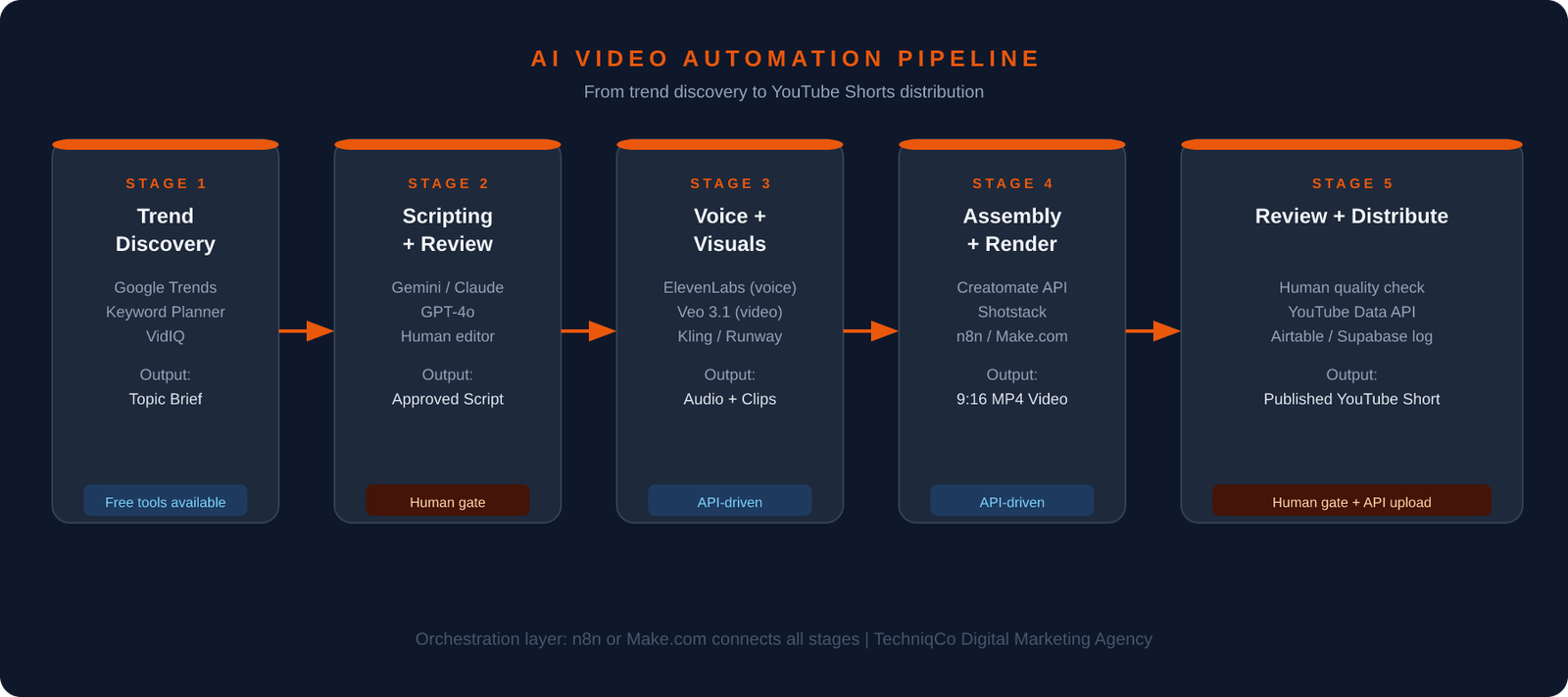
Trend Discovery
Automated data harvesting across search and social intent signals. Identifies rising queries before competition saturates the topic.
Scripting & Review
Large language models generate structured, scene-by-scene drafts. An editor refines hooks, verifies claims, and signs off.
Audio & Visual Gen
High-fidelity voice synthesis generates calibrated narration while diffusion models render vertical 9:16 background clips.
Assembly & Captions
Cloud rendering APIs combine audio tracks, b-roll, animated kinetic subtitles, sound effects, and brand overlays into master MP4 files.
Quality & Policy Audit
Producer inspects rendered video for pacing, lip-sync or caption drift, visual consistency, and platform disclosure requirements.
Distribution & Telemetry
Automated publishing via YouTube Data API with rich metadata. Real-time watch retention telemetry feeds into future topic scoring.
Stage 1: Trend Discovery and Topic Qualification
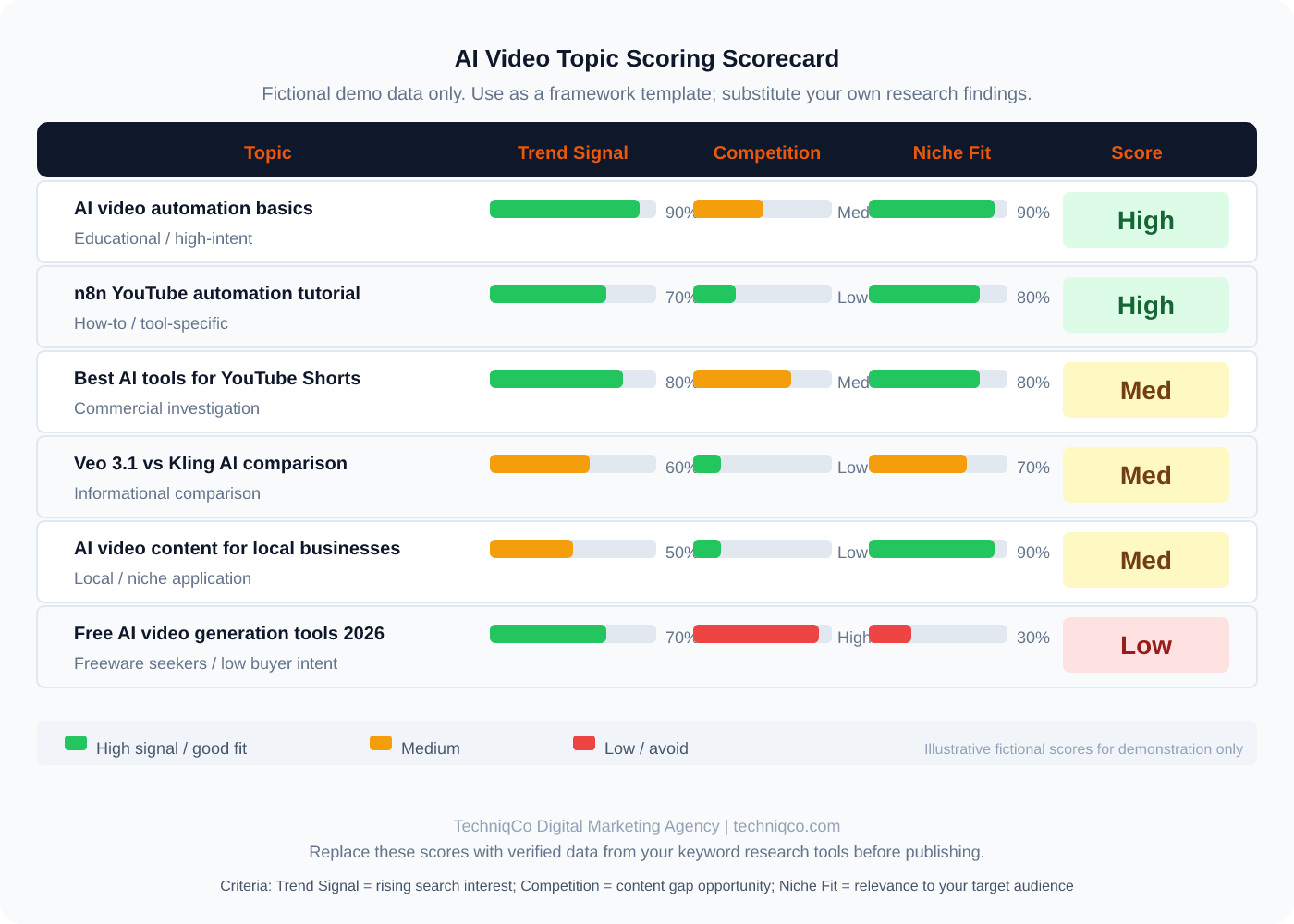
Without systematic topic qualification, automated pipelines rapidly burn compute rendering videos nobody wants to watch. Early-stage discovery establishes whether consumer interest is accelerating before investing in production.
Google Trends supplies relative interest index trajectories, revealing emerging search spikes across geographical targets. In contrast, Google Keyword Planner provides estimated volume intervals within Google Ads. When orchestrating short-form video pipelines, pairing Google search trajectories with YouTube query velocities reveals precise gaps where video supply fails to satisfy viewer queries.
For detailed methodologies on trend harvesting, refer to our comprehensive analyses on how to find trending keywords before competitors and evaluating query velocity via our Google Trends vs Keyword Planner comparison guide.
Stage 2: Algorithmic Scripting and Human Editorial Control
Generative models excel at synthesizing information into punchy narrative scripts. Modern pipelines prompt reasoning models such as Gemini 1.5/2.0 or Claude to format scripts into tight 50-to-60 second timecodes:
- 0:00 to 0:03 (The Hook): Disruptive visual statement or counter-intuitive claim eliminating scroll friction.
- 0:03 to 0:15 (The Core Tension): Clarification of the problem or opportunity confronting the viewer.
- 0:15 to 0:45 (The Resolution / Value Delivery): Three concise, actionable insights supported by clear on-screen visual prompts.
- 0:45 to 0:55 (Call to Engagement): Natural conclusion prompting discussion or profile navigation.
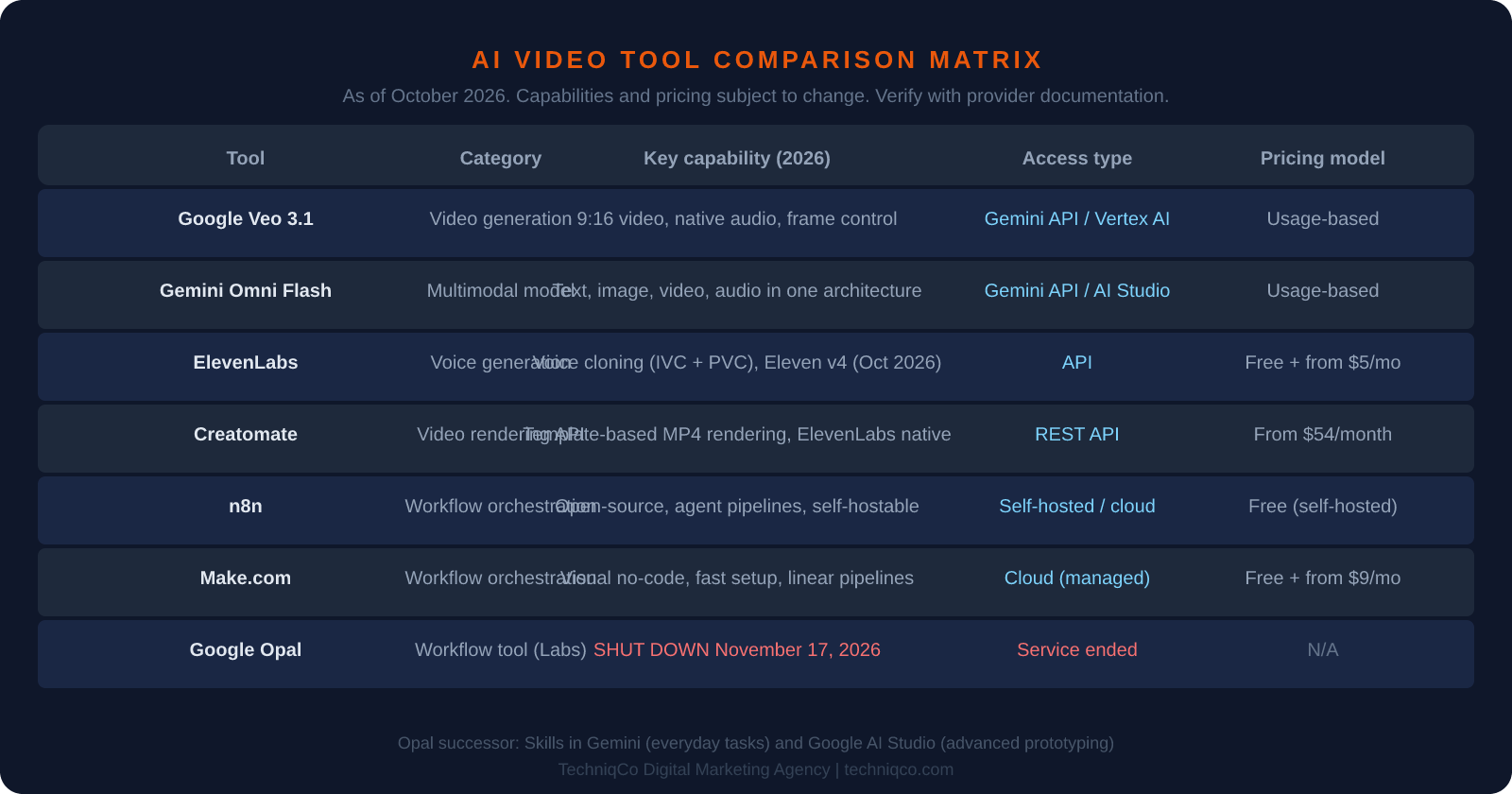
Google has officially announced that experimental workflow service Google Opal will shut down on November 17, 2026. Core workflow agent capabilities developed during the Opal experiment have officially graduated into Skills in Gemini and enterprise-grade Google AI Studio. Existing Opal project files in Google Drive (My Drive > Opal) will be preserved, but interactive executions will cease. Creators utilizing Opal workflows must manually migrate their system prompts and schemas to Gemini Skills or AI Studio before November 17, 2026.
Stage 3: High-Fidelity Voice Synthesis and Diffusion Video Rendering
Once the editorial gate approves the script, assets generate in parallel across specialized endpoints:
1. AI Voiceover Synthesis (ElevenLabs)
Synthetic voiceover has transcended robotic monotony. With the introduction of the Eleven v4 architecture, models capture micro-inflections, conversational pacing, and genuine emotional cadence. For brand continuity, businesses leverage Professional Voice Cloning (PVC) trained on authorized executive studio audio, ensuring consistent narrative identity across hundreds of automated video assets.
2. Video Generation (Google Veo 3.1 & Multimodal Engines)
On the visual front, Google Veo 3.1 represents a generational leap accessible programmatically via the Gemini API and Google Cloud Vertex AI. Veo 3.1 provides native vertical 9:16 rendering at up to 4K resolution, eliminating distortion from letterboxing. Crucially, Veo 3.1 incorporates first-and-last frame visual constraints and reference image conditioning, significantly curtailing character drift. For unified pipelines, Google’s multimodal Gemini Omni Flash increasingly unifies script reasoning, reference generation, and video synthesis within a cohesive environment.
Complementary diffusion platforms like Kling AI 3.0 and Runway Gen-4.5 provide alternative aesthetic profiles, with mature creative teams selecting rendering endpoints based on scene complexity.
Stage 4 & 5: Cloud Video Assembly and Workflow Orchestration
Connecting discrete API endpoints into a cohesive factory requires two critical infrastructure elements: a rendering engine and an orchestration brain.
Programmatic Assembly via Creatomate
Render engines such as Creatomate and Shotstack transform fragmented audio and video files into polished social media assets. By establishing a parameterized template, an automation platform passes a structured JSON payload containing:
- ElevenLabs audio narration URL
- Veo 3.1 / stock b-roll background video streams
- Kinetic animated subtitles auto-transcribed from audio
- Brand watermarks, color palettes, and CTA end-cards
The cloud render engine compiles these assets server-side, returning an optimized MP4 stream within minutes.
The Orchestration Engine: n8n vs Make.com
Workflow orchestration coordinates the sequence. Rather than writing custom microservices from scratch, teams deploy low-code logic engines:
- n8n: The preferred architecture for engineering-led teams and high-volume production. Self-hosted on Docker, n8n avoids prohibitive per-step execution pricing, offers granular JavaScript branching, and connects seamlessly to local databases and AI agents.
- Make.com: Ideal for rapid deployment and non-technical marketing teams. Offers intuitive visual canvas debugging and instant OAuth integrations at predictable SaaS tiers.
Production Efficiency: Traditional vs AI-Assisted Workflows
To understand the economic advantage of an automated video architecture, consider the operational variance between legacy studio production and an agentic pipeline:
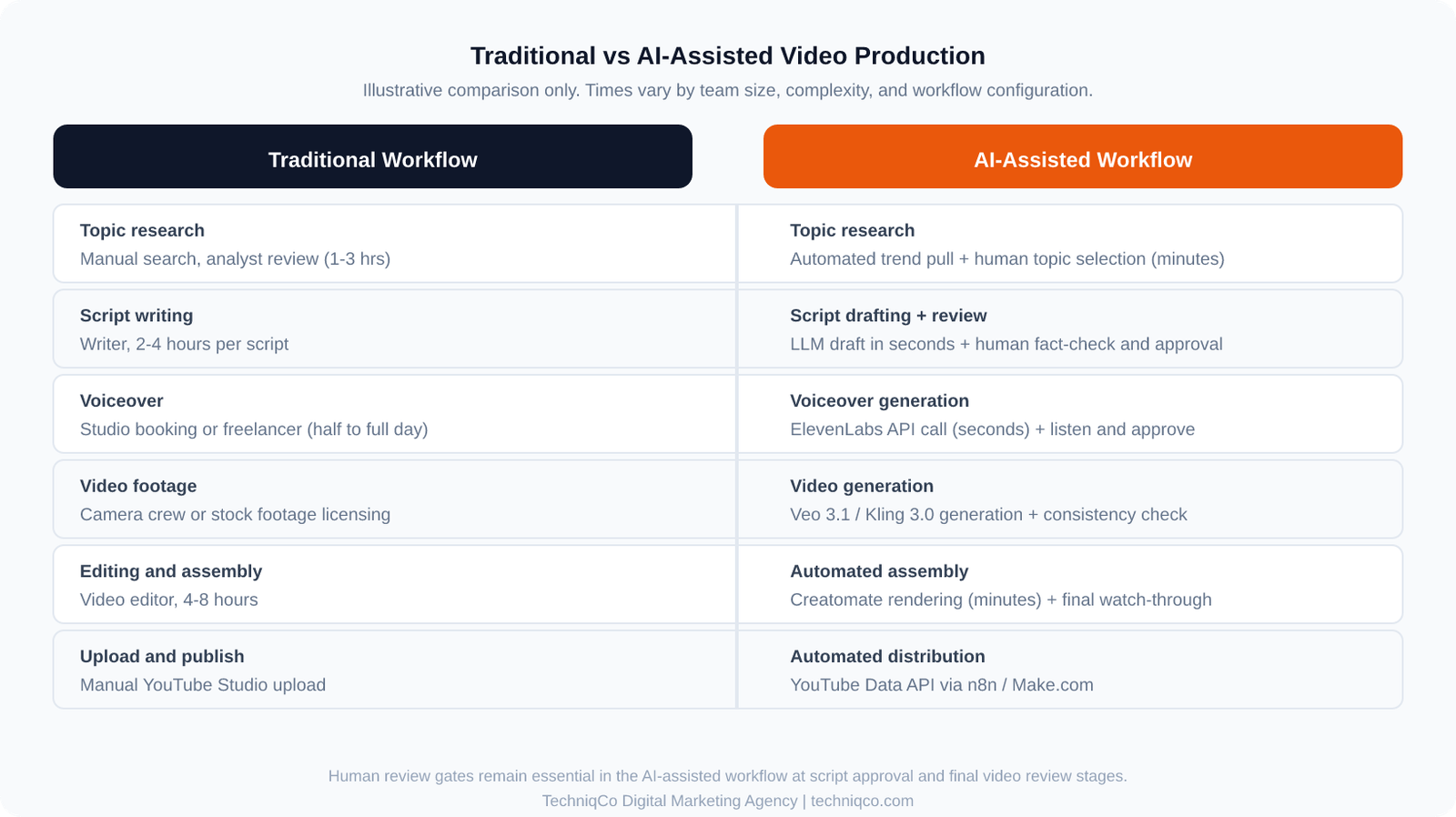
| Workflow Stage | Traditional Agency Model | Automated AI Pipeline | Human Oversight Focus |
|---|---|---|---|
| Topic Research | Manual review (2 to 4 hours) | Algorithmic trend pull (< 5 mins) | Strategic topic selection & curation |
| Scriptwriting | Copywriter draft (3 to 5 hours) | LLM structured draft (seconds) | Fact-checking, tone, & hook polish |
| Voice Narration | Voice talent scheduling (1 to 2 days) | ElevenLabs PVC API call (< 1 min) | Pronunciation & cadence audit |
| Visual Footage | Live production or stock licensing | Veo 3.1 vertical diffusion | Artifact & consistency verification |
| Video Assembly | Manual NLE timeline edit (4 to 8 hours) | Creatomate cloud render (2 mins) | Final pre-publish quality approval |
| Distribution | Manual export, tag, & schedule | Automated YouTube Data API upload | Campaign timing & audience targeting |
Stage 6: Multi-Surface Distribution and Closed-Loop Analytics
The final mile of an automation pipeline transitions rendered media into organic distribution. The automation platform sends authorized OAuth2 requests to the YouTube Data API, transferring the MP4 asset along with optimized titles, descriptive summaries, topic tags, and relevant category IDs.
Publishing alone does not complete the loop. Enterprise systems connect to telemetry databases (such as Supabase or Airtable) to track 24-hour, 7-day, and 30-day view velocities, average percentage viewed (APV), and subscriber acquisition rates. Topics generating top-quartile retention are automatically logged into discovery seeds for subsequent video batches, continuously refining production intelligence.
For teams integrating paid amplification, our analysis on Google Demand Gen and YouTube Ads updates details how algorithmic audience matching accelerates organic reach across Google and YouTube surfaces.
Frequently Asked Questions
Is YouTube Shorts automation allowed under platform policies?
Yes. YouTube policies do not ban automation software or artificial intelligence tools. YouTube enforces strict rules against repetitive, mass-produced content that provides no substantive educational or entertainment value. Channels using AI pipelines with rigorous human editorial review to produce authentic, high-quality content remain fully compliant and monetizable.
Do I need to disclose AI-generated video on YouTube?
YouTube requires creators to check the altered content disclosure box in YouTube Studio if the video depicts realistic people saying or doing things they did not, alters genuine event footage, or portrays realistic events that never occurred. Synthetic illustrations, animated graphics, and stylized b-roll generally do not trigger mandatory disclosure requirements.
What parts of the video production pipeline can be safely automated?
Trend data harvesting, initial script formatting, voice synthesis, generative b-roll creation, timeline assembly, caption burning, and metadata publishing can all run programmatically. Fact-checking, brand voice calibration, visual artifact inspection, and final publication sign-off must remain human responsibilities.
Which generative models provide the best results for YouTube Shorts?
For programmatic enterprise scaling, Google Veo 3.1 accessed through Vertex AI and the Gemini API provides native 9:16 vertical 4K output with frame conditioning and synchronized audio. For third-party pipelines, Runway Gen-4.5 and Kling AI 3.0 deliver strong aesthetic consistency.
What happened to Google Opal for workflow automation?
Google Opal was an experimental Google Labs workflow system that will shut down on November 17, 2026. Its core capabilities have graduated into Skills in Gemini and Google AI Studio. Existing files remain in Google Drive, but users must manually move active prompts to Gemini Skills or AI Studio before the shutdown date.
Can automated YouTube Shorts qualify for the YouTube Partner Program?
Yes. Monetization eligibility is determined by compliance with the YouTube Partner Program guidelines, community standards, and copyright regulations, rather than whether tools assisted the production. Provided content meets 1,000 subscribers and 10 million valid public Shorts views within 90 days (or 4,000 long-form watch hours) and offers genuine original commentary, monetization is fully supported.
Ready to Build a Scalable AI Video Content Engine?
Producing compliant, high-performing organic video at scale requires seasoned architectural planning. TechniqCo helps brands and media agencies design resilient AI video pipelines, integrate automated trend discovery, curate voice identities, and dominate search-driven social surfaces.
Consult TechniqCo AI Marketing Specialists →Related posts:
 Gemini AI Editor for YouTube: Features, How It Works, and What Creators Need to Know in 2026
 How to Find Trending Keywords Before Your Competitors in 2026
 Google Trends vs Google Keyword Planner: Which Is Better for SEO in 2026?
 The Advanced AI Prompt Playbook: ChatGPT Prompts for SEO, GEO, and AEO in 2026
 Gemini 4 Argon vs GPT vs Claude: What Businesses Should Know in 2026
 How to Use Google Trends for SEO in 2026