Written by Trivender Singh
Co-Founder at TechniqCo | GEO & AEO Expert specializing in Generative Engine Optimization, Answer Engine Optimization, AI Search Visibility, Technical SEO & Business Growth Scaling.
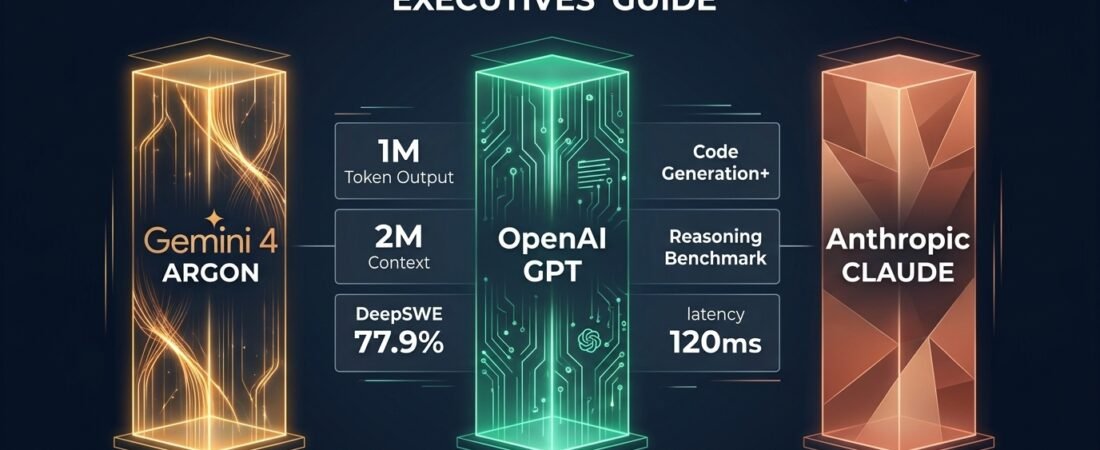
Google announced Gemini 4 Argon on September 30, 2026, introducing a frontier model engineered specifically for long-horizon autonomous reasoning, full-repository software engineering, enterprise workflow automation, and defensive cybersecurity. It stands out technically by offering a 1-million-token output ceiling alongside its multi-million token long-context capacity.
In contrast, OpenAI and Anthropic provide mature, generally available commercial ecosystems with active October 2026 model lineups. OpenAI offers its GPT-6 family (GPT-6 Astra, GPT-6.1 Sol, and GPT-6 Luna, all featuring a 1.05M token context window and 128K output capacity), while Anthropic provides its Claude 5.x generation (Claude Opus 5.5, Claude Sonnet 5.5, and Claude Fable 5.1).
There is no universally superior AI model for enterprise operations in 2026. Practical differences depend heavily on workload parameters: repository scale, document volume, required latency, inference budgets, tool integrations, and operational governance. Gemini 4 Argon introduces distinctive capabilities for massive codebases and security auditing, while OpenAI and Anthropic remain deeply embedded options for immediate enterprise deployment.
Gemini 4 Argon vs GPT vs Claude: 10 Objective Dimensions
The following table summarizes documented specifications, pricing schedules, and operational characteristics across the three primary frontier ecosystems as of October 2, 2026.
What Is Gemini 4 Argon?
Gemini 4 Argon is Google’s newest frontier foundation model, announced officially on September 30, 2026, by Google DeepMind and Google Cloud leadership. Rather than optimizing primarily for conversational responsiveness or incremental text generation speed, Google engineered Argon to tackle high-friction enterprise bottlenecks: multi-step autonomous planning, vast codebase maintenance, legacy software migration, and defensive cybersecurity operations.
Technically, Gemini 4 Argon pairs Google’s established multi-million token input context architecture with a 1,000,000-token generation capacity. This architectural shift addresses a common constraint in generative systems, where models could ingest expansive datasets but were limited to returning truncated fragments, summaries, or disjointed code patches.
Access to Gemini 4 Argon is currently staged. Google is deploying the model first through its Fairwind Program, an initiative dedicated to equipping verified cybersecurity organizations and defensive operators with automated vulnerability identification and remediation tools. Wider commercial distribution for enterprise organizations, software development teams, and Google AI Ultra consumers is planned in subsequent rollout phases.
Google’s internal disclosures note that engineering teams within Alphabet have tested Argon to plan repository framework migrations, resolve complex dependency conflicts, and audit distributed services.
What Makes Gemini 4 Argon Different?
Google highlighted seven distinct operational capabilities in its launch documentation. Each capability presents both practical business implications and real-world operational constraints.
+-----------------------------------------------------------------------+
|                       GEMINI 4 ARGON CORE PROFILE                     |
|                                                                       |
|   +---------------------------------------------------------------+   |
|   | Multi-Million Token Ingestion Capacity                        |   |
|   | Full enterprise codebases, multi-hour video, regulatory files |   |
|   +-------------------------------+-------------------------------+   |
|                                   |                                   |
|                                   v                                   |
|   +---------------------------------------------------------------+   |
|   | Long-Horizon Reasoning Design                                 |   |
|   | Designed for extended planning, step review, and workflows    |   |
|   +-------------------------------+-------------------------------+   |
|                                   |                                   |
|                                   v                                   |
|   +---------------------------------------------------------------+   |
|   | 1,000,000 Token Output Ceiling                                |   |
|   | Multi-file refactors, complete test suites, remediation plans |   |
|   +-------------------------------+-------------------------------+   |
+-----------------------------------------------------------------------+
1. Long-Horizon Reasoning
Google describes Argon as designed for extended reasoning and long-horizon workflows. Frontier models often encounter compounding errors when executing complex tasks requiring ten or more sequential operations. Google indicates that Argon is trained to sustain goal adherence over prolonged execution cycles.
- Practical Implication: Supports multi-step business processes such as cross-database schema synchronization, regulatory audit generation, or deep architectural analysis.
- Critical Limitation: Extended reasoning introduces latency. Multi-step workflows require significant processing time, making Argon unsuitable for synchronous, low-latency conversational applications.
2. Large-Scale Software Engineering
Google reported a score of 77.9% on the DeepSWE v1.1 benchmark Google DeepMind Technical Disclosure, an evaluation testing an AI system’s ability to resolve real-world software engineering issues across production GitHub repositories. This benchmark requires analyzing issue descriptions, locating relevant modules across hundreds of files, formulating patches, and checking backward compatibility.
- Practical Implication: Engineering organizations can test automated workflows for tasks such as framework upgrades, library migrations, and legacy code maintenance.
- Critical Limitation: DeepSWE scores do not guarantee flawless execution in proprietary corporate environments that lack documentation or comprehensive unit test coverage.
3. 1 Million Token Output
Traditional generative models typically cap generation between 4,096 and 128,000 tokens. Generating complete multi-file components or extensive documentation previously required middleware pipelines that stitched together fragmented responses. Argon’s 1-million-token output allows large codebases, documentation libraries, and test suites to generate in a continuous output stream.
- Practical Implication: Simplifies or eliminates middleware previously required to orchestrate and concatenate chunked outputs.
- Critical Limitation: Output scale does not ensure code quality. An uncompiled million-token code generation can still fail build pipelines, break runtime dependencies, or introduce subtle logic defects.
4. Enterprise Workflows
Google evaluated Argon on AutomationBench, an evaluation framework measuring end-to-end task completion across enterprise software tools, reporting a score of 51.3% Google Official Announcement. The benchmark evaluates tasks involving ERP updates, spreadsheet manipulation, email drafting, and CRM reconciliation.
- Practical Implication: Back-office teams can explore semi-autonomous agents that coordinate administrative steps across multiple business platforms.
- Critical Limitation: Autonomous task execution across enterprise databases requires strict authorization gates, audit logs, and sandbox environments to prevent erroneous data modifications.
5. Defensive Cybersecurity
Defensive security is central to Argon’s initial deployment strategy. On CWE-bench v1, which evaluates automated identification and remediation of Common Weakness Enumeration vulnerabilities, Google reported a score of 68% Google Official Announcement. Through the Fairwind Program, participating security teams use Argon to inspect source code, identify vulnerability paths, and generate candidate pull requests containing verified security patches.
- Practical Implication: Security operations teams can explore automated triage for routine CVEs across internal software assets.
- Critical Limitation: Automated security patches require human code review before merging into production environments to avoid introducing regressions.
6. Multimodal and Long-Form Understanding
Argon achieved 91.7% on LVBench Google DeepMind Technical Disclosure, a benchmark designed to evaluate long-form video comprehension and information retrieval across hours of footage.
- Practical Implication: Companies can process complete technical recordings, plant walkthroughs, architectural presentations, or customer service archives in a single context session.
- Critical Limitation: Ingesting large video and audio files creates significant token volume, making prompt caching critical to managing ongoing operational costs.
7. Agentic Workflows
Google positions Argon as an engine for agentic workflows capable of planning tasks, calling external tools, and managing intermediate execution states over extended periods.
- Practical Implication: Software teams can build asynchronous agents to assist with issue backlogs and automated code maintenance.
- Critical Limitation: Agent reliability depends heavily on the quality of external feedback signals, such as compilers, test runners, and structured API responses.
Output Token Limit vs Input Context Window: An Essential Distinction
Business evaluators often conflate a model’s input context window with its output token limit. The distinction is fundamental when planning technical architecture and computing operational budgets.
+---------------------------------------------------------------------------+
|                          INPUT CONTEXT WINDOW                             |
|  What the model can ingest, analyze, and reference simultaneously         |
|  Examples: Ingesting code repositories, legal filings, or video streams    |
+---------------------------------------------------------------------------+
                                     |
                                     v
+---------------------------------------------------------------------------+
|                           REASONING CAPACITY                              |
|  How effectively the model evaluates relationships within the input data  |
+---------------------------------------------------------------------------+
                                     |
                                     v
+---------------------------------------------------------------------------+
|                          OUTPUT TOKEN CEILING                             |
|  What the model can generate in a single uninterrupted response stream    |
|  Examples: Returning code files, complete reports, or data structures     |
+---------------------------------------------------------------------------+
An expanded input window allows an organization to provide complete technical manuals, multi-year compliance archives, or hours of recorded media directly in the prompt context. The model reads and references this information simultaneously.
An output token limit dictates how much text, code, or structured data the model can produce in a single request:
- Every generated token requires sequential computation, increasing the total time required to receive the response.
- Error accumulation can occur across long generations, potentially leading to syntax errors or hallucinations in late-stage output.
- Generating 1,000,000 tokens represents a direct per-request cost ($10.00 at introductory rates, $20.00 at standard rates), regardless of whether the generated output compiles or runs successfully.
Argon’s large context capacity can reduce the need for aggressive chunking in some document-heavy workflows, although retrieval architectures may still be useful for freshness, cost control, access control, and selective context. For production deployments, generating modular, independently testable components with validation gates at each boundary remains a safer architecture than relying on single-pass monolithic generations.
Gemini 4 Argon vs OpenAI (GPT-6 Astra, GPT-6.1 Sol, GPT-6 Luna)
As of October 2026, OpenAI’s production offerings are centered on the GPT-6 family, which includes GPT-6 Astra (positioned as its most capable model for demanding reasoning and coding), GPT-6.1 Sol (balancing high performance and cost efficiency), and GPT-6 Luna (optimized for cost-sensitive, high-volume tasks) OpenAI Model Documentation.
+-----------------------------------------------------------------------+
|                    ARCHITECTURAL COMPARISON: GOOGLE vs OPENAI         |
|                                                                       |
|   GOOGLE GEMINI 4 ARGON:                                              |
|   Unified Long-Context Engine                                         |
|   [Multi-Million Ingestion] ---> [Extended Reasoning] ---> [1M Output] |
|                                                                       |
|   OPENAI GPT-6 FAMILY (Astra / Sol / Luna):                           |
|   Tiered Multimodal Architecture                                      |
|   [1.05M Token Context] ---> [Adaptive Deliberation] ---> [128k Output]|
|   (Supported by 'dots' always-on agent framework & Azure integration) |
+-----------------------------------------------------------------------+
Context and Output Capacities
OpenAI standardizes a 1.05M-token context window across GPT-6 Astra, GPT-6.1 Sol, and GPT-6 Luna, with a maximum output ceiling of 128,000 tokens OpenAI Model Documentation.
Gemini 4 Argon provides a larger output ceiling, supporting up to 1,000,000 output tokens in a single generation stream. This allows complete codebases or extensive documentation suites to be returned in one response. For applications that require generations exceeding 128k tokens, Argon provides native single-stream capability, whereas OpenAI models require client-side chunking or multi-step agent orchestration.
Pricing Structure
OpenAI employs a tiered pricing schedule across its GPT-6 models OpenAI Pricing Schedule:
- GPT-6.1 Sol: $2.00 per 1M input tokens and $10.00 per 1M output tokens for standard context, with cached input priced at $0.10 per 1M tokens. For long-context requests, pricing shifts to $4.00 input and $15.00 output ($0.20 cached).
- GPT-6 Astra: $10.00 per 1M input tokens and $50.00 per 1M output tokens for standard context ($1.00 cached), shifting to $20.00 input and $75.00 output for long-context workloads ($2.00 cached).
- GPT-6 Luna: $0.10 per 1M input tokens and $0.50 per 1M output tokens ($0.01 cached), shifting to $0.20 input and $0.75 output for long-context tasks ($0.02 cached).
Gemini 4 Argon offers introductory pricing of $2.00 input and $10.00 output per 1M tokens ($4.00 and $20.00 standard), with a 95% cached input discount ($0.10 to $0.20 per 1M tokens).
Reasoning and Agent Architecture
OpenAI introduced its “dots” always-on agent framework at DevDay 2026, allowing background digital workers to maintain persistent state and execute recurring operational tasks. OpenAI has a broad developer and API ecosystem with extensive third-party SDK and library integrations.
Google describes Gemini 4 Argon as engineered for extended reasoning across long-horizon workflows. While OpenAI offers a tiered portfolio ranging from ultra-low-cost utility (Luna) to heavy deliberation (Astra), Argon focuses its resources on prolonged, multi-step engineering tasks and defensive security patching.
Gemini 4 Argon vs Anthropic Claude (Opus 5.5, Sonnet 5.5, Fable 5.1)
Anthropic’s production lineup as of October 2026 is centered on its Claude 5.x generation, officially launched in September 2026 Anthropic Newsroom. The family includes Claude Sonnet 5.5 (flagship for coding and knowledge work), Claude Opus 5.5 (delivering deep analytical reasoning at reduced operational costs), and Claude Fable 5.1 (engineered for long-running research and autonomous agents).
+-----------------------------------------------------------------------+
|                   ARCHITECTURAL COMPARISON: GOOGLE vs ANTHROPIC       |
|                                                                       |
|   GOOGLE GEMINI 4 ARGON:                                              |
|   Vast Scale & Monolithic Execution                                   |
|   [Multi-Million Ingestion] =====> [1,000,000 Token Output Ceiling]   |
|                                                                       |
|   ANTHROPIC CLAUDE 5.x (Opus 5.5 / Sonnet 5.5 / Fable 5.1):           |
|   Controlled Reasoning & Open Standards                               |
|   [200k-500k Context] =====> [64k-128k Token Output Ceiling]          |
|   (Model Context Protocol + Native Computer Use + Claude Code CLI)    |
+-----------------------------------------------------------------------+
Reasoning Control and Developer Workflows
Anthropic’s Claude 5.x models offer configurable reasoning budgets, allowing developers to allocate thinking tokens based on the complexity of each incoming query. Claude Fable 5.1 is tuned for demanding scientific research and sustained agentic analysis. Anthropic’s Claude Code command-line tool provides a terminal workflow that integrates closely with local developer environments.
Google describes Gemini 4 Argon as built for extended reasoning across long-horizon workflows. While Claude provides developers with granular parameters to balance token costs and latency on a per-request basis, Argon is built to sustain extended batch processes across large repositories.
Pricing and Context Capacity
Anthropic prices Claude Sonnet 5.5 at $2.00 per 1M input tokens and $10.00 per 1M output tokens Anthropic Newsroom, matching the introductory rates of Gemini 4 Argon and OpenAI’s GPT-6.1 Sol. For high-complexity tasks, Claude Opus 5.5 and Fable 5.1 are priced at $15.00 input and $75.00 output per 1M tokens. Anthropic’s prompt caching provides up to a 90% discount on cached tokens.
Claude models operate across context windows between 200,000 and 500,000 tokens with output ceilings between 64,000 and 128,000 tokens. Argon supports multi-million token ingestion alongside its 1,000,000-token output limit.
Tool Standards: MCP vs Cloud-Native Services
Anthropic created the Model Context Protocol (MCP), an open standard that allows models to connect cleanly to local file systems, enterprise databases, and business software tools. Anthropic also provides native Computer Use capabilities, enabling models to interact directly with desktop software interfaces.
Google provides native integration for Gemini 4 Argon within Google Cloud, Vertex AI, and Google Workspace. Organizations building multi-cloud or open-source agent pipelines often utilize Anthropic’s MCP, while organizations standardized on Google Cloud benefit from native Vertex AI integrations.
Benchmarks: Gemini 4 Argon vs GPT vs Claude
Cross-vendor AI benchmarking requires careful context. Differences in system prompting, evaluation harnesses, scaffold tooling, and potential benchmark contamination mean published scores should be interpreted as directional indicators rather than absolute measurements.
+-----------------------------------------------------------------------+
|                    HEADLINE BENCHMARK COMPARISONS                     |
|                                                                       |
|   DeepSWE v1.1 (Autonomous Software Engineering):                     |
|   Gemini 4 Argon:  [======================= 77.9% ] (Google-reported)  |
|                                                                       |
|   AutomationBench (End-to-End Enterprise Automation):                 |
|   Gemini 4 Argon:  [=============== 51.3% ] (Google-reported, #1)     |
|                                                                       |
|   LVBench (Long-Video Understanding):                                 |
|   Gemini 4 Argon:  [=========================== 91.7% ] (Google-rep.) |
|                                                                       |
|   CWE-bench v1 (Automated Security Vulnerability Patching):           |
|   Gemini 4 Argon:  [==================== 68.0% ] (Google-reported)   |
+-----------------------------------------------------------------------+
Google-Reported Results for Gemini 4 Argon
- DeepSWE v1.1: 77.9% Google DeepMind Technical Disclosure. Measures autonomous resolution of software engineering tasks across production repositories. Google presents this result as evidence of Argon’s multi-step planning capability.
- AutomationBench: 51.3% Google Official Announcement. Measures multi-step task completion across enterprise software tools. Google reports this as the top recorded score on this evaluation.
- LVBench: 91.7% Google DeepMind Technical Disclosure. Evaluates long-form video comprehension and granular information retrieval across hours of video footage.
- CWE-bench v1: 68.0% Google Official Announcement. Measures automated vulnerability identification and patch generation for Common Weakness Enumeration issues, tying for first place among evaluated systems.
OpenAI Benchmark Positioning (2026 Models)
- OpenAI reports high performance for its GPT-6 models across standard evaluations, including SWE-bench Verified, competitive programming platforms, and complex reasoning benchmarks such as MATH-500 and GPQA Diamond OpenAI DevDay Disclosures.
- When evaluated with iterative tool execution and compiler feedback, OpenAI models demonstrate strong precision on targeted algorithmic and function-level programming tasks.
Anthropic Benchmark Positioning (2026 Models)
- Anthropic reports high completion rates for Claude Sonnet 5.5 and Claude Opus 5.5 on SWE-bench Verified, particularly when paired with interactive terminal workflows such as Claude Code Anthropic Newsroom.
- On agentic evaluations assessing terminal execution, tool use, and interface navigation via Computer Use, Anthropic models demonstrate strong reliability attributed to precise structured output and instruction adherence.
Benchmark Limitations in Enterprise Evaluation
- Scaffolding and Tooling Variations: Benchmark scores depend heavily on the software harness surrounding the model. A model evaluated within a multi-turn agent loop with compiler feedback and automated test runs will score substantially higher than the exact same model evaluated on single-shot completions.
- Benchmark Contamination: As public benchmark tasks circulate online, synthetic variations can inadvertently enter training datasets, inflating evaluation metrics without yielding real-world enterprise improvements.
- Synthetic vs Proprietary Enterprise Code: Standard coding benchmarks evaluate clean open-source repositories with established unit test suites. Proprietary enterprise software often features undocumented dependencies, legacy frameworks, absent test suites, and complex business logic where performance may vary significantly.
Pricing Comparison: API Economics vs Consumer Subscriptions
Enterprise decision-makers must distinguish between developer API pricing (billed per million tokens of actual compute) and consumer subscription pricing (flat monthly platform access fees). A monthly desktop subscription provides personal productivity access with rate limits, while production business applications require pay-per-token API architectures backed by enterprise SLAs.
API Token Pricing Schedule (As of October 2, 2026)
Key Economic Takeaways
- Impact of Prompt Caching: When building systems that repeatedly pass large codebases, brand guidelines, or legal documentation, prompt caching significantly influences overall costs. Google’s 95% caching discount ($0.10 per 1M input) and OpenAI/Anthropic cached rates allow multi-megabyte document analysis at fractional costs compared to non-cached execution.
- Cost of Output Tokens: Across all providers, output generation costs four to five times more than input processing. A single 1-million-token output execution on Gemini 4 Argon costs $10.00 during the introductory window and $20.00 at standard rates. If an autonomous agent runs in an unconstrained loop generating thousands of lines of redundant code, compute costs can accumulate quickly.
- Consumer Subscriptions vs Enterprise APIs: Services such as ChatGPT Plus/Pro ($20 to $200/month), Claude Pro/Team ($20 to $30/user/month), and Google AI Ultra represent personal productivity tools with usage caps. They cannot power backend business applications, which require pay-per-token API access with data isolation guarantees.
Which Model Fits Which Business Workflow?
Rather than attempting to designate a single winner, enterprise technology leaders should evaluate models based on how their documented characteristics align with specific workload requirements.
+-----------------------------------------------------------------------+
|                    WORKLOAD EVALUATION FRAMEWORK                      |
|                                                                       |
|  Massive Repositories / Multi-Hour Video / Security Remediation       |
|  ======> RELEVANT TO EVALUATE: Google Gemini 4 Argon                  |
|                                                                       |
|  Interactive Coding / Structured Documents / Open Agent Standards     |
|  ======> RELEVANT TO EVALUATE: Anthropic Claude Sonnet 5.5 / Opus 5.5 |
|                                                                       |
|  High-Volume API / 1.05M Context / Tiered Workload Routing            |
|  ======> RELEVANT TO EVALUATE: OpenAI GPT-6 (Astra / Sol / Luna)      |
+-----------------------------------------------------------------------+
1. Legacy Software Modernization
- Workflow Profile: Migrating monolithic architectures (such as upgrading enterprise Java systems or refactoring legacy modules) requiring broad context across hundreds of interlinked files.
- Models to Evaluate: Gemini 4 Argon and Claude Sonnet 5.5. Argon’s multi-million token context and 1M output ceiling allow generation of complete microservice replacements along with comprehensive test harnesses in a single pass. For teams performing interactive, file-by-file refactoring within developer terminals, Claude Sonnet 5.5 paired with Claude Code provides strong instruction following and localized editing precision.
2. Large Codebase Architecture Analysis
- Workflow Profile: Auditing enterprise repositories for architectural consistency, circular dependencies, and cross-service technical debt.
- Models to Evaluate: Gemini 4 Argon and OpenAI GPT-6 Astra. Both models support 1M+ token context windows, enabling processing of large repository snapshots in single sessions, which can help surface cross-module relationships that retrieval-augmented generation (RAG) systems may overlook.
3. High-Volume Customer Support
- Workflow Profile: Customer-facing triage, automated helpdesk resolution, and real-time interactive communication across voice and web channels.
- Models to Evaluate: OpenAI GPT-6 Luna or Claude 5.x Haiku-tier models. Customer support applications require low latency, predictable costs ($0.10/$0.50 on Luna), and conversational naturalism. Argon’s extended reasoning focus and large output capacity offer limited utility in short-turn support chats while adding unnecessary latency.
4. Enterprise Legal and Regulatory Document Analysis
- Workflow Profile: Synthesizing hundreds of pages of complex contracts, compliance disclosures, merger filings, or clinical trial documentation.
- Models to Evaluate: Claude Sonnet 5.5 / Opus 5.5, OpenAI GPT-6 Astra, and Gemini 4 Argon. Claude models can be included in the evaluation when the workflow emphasizes long-form document analysis and structured reasoning. Gemini 4 Argon is relevant when total document volume exceeds 500k tokens, allowing legal teams to query multiple complete filings without splitting files.
5. Content Strategy and Marketing Communications
- Workflow Profile: Generating long-form editorial content, brand-aligned communications, email sequences, and market research briefs.
- Models to Evaluate: Claude Sonnet 5.5 and OpenAI GPT-6.1 Sol. Claude models are frequently chosen by editorial teams for their nuanced tone and clear prose structure. OpenAI’s GPT-6.1 Sol serves as an effective option for rapid drafting, social media variations, and ideation.
6. Complex Financial and Quantitative Data Analysis
- Workflow Profile: Modeling market scenarios, conducting multi-step financial reconciliations, and writing algorithmic analysis scripts against tabular datasets.
- Models to Evaluate: OpenAI GPT-6 Astra and Claude Opus 5.5. Both models demonstrate strong mathematical formulation and algorithmic precision, with reasoning architectures designed to validate calculations systematically.
7. Asynchronous Multi-Step AI Agents
- Workflow Profile: Digital assistants deployed to resolve technical support tickets, sync multi-system enterprise records, or execute background research tasks.
- Models to Evaluate: Anthropic Claude Fable 5.1 / Sonnet 5.5 (utilizing the Model Context Protocol and Computer Use) and OpenAI GPT-6 Astra (leveraging the dots agent architecture). For autonomous software maintenance inside sandboxed cloud environments, Gemini 4 Argon is also worth evaluating based on its reported AutomationBench and DeepSWE benchmark results.
8. Defensive Cybersecurity and Patch Management
- Workflow Profile: Automated vulnerability triage, exploit verification, CVE remediation, and static analysis across corporate codebases.
- Models to Evaluate: Gemini 4 Argon. Google specifically positioned Argon for this workload through its Fairwind Program. Organizations with extensive internal software assets should evaluate Argon for automated vulnerability remediation.
9. Academic and Scientific Research
- Workflow Profile: Ingesting scientific literature, synthesizing research findings, and formulating hypotheses based on multi-disciplinary studies.
- Models to Evaluate: Claude Opus 5.5 / Fable 5.1, OpenAI GPT-6 Astra, and Gemini 4 Argon. Research teams often pair models: Claude or OpenAI for analytical deductions, and Gemini 4 Argon for ingesting large collections of academic papers and video lectures simultaneously.
10. High-Throughput API Automation
- Workflow Profile: High-volume processing tasks such as entity extraction, sentiment scoring, transaction tagging, and automated classification across millions of records.
- Models to Evaluate: Lightweight models such as OpenAI GPT-6 Luna ($0.10/$0.50 per 1M tokens), Claude 5.x Haiku-tier, or Gemini 2.5 Flash. Running massive classification workloads through frontier models like Gemini 4 Argon or Claude Opus 5.5 incurs unnecessary operational costs without measurable accuracy benefits.
Gemini 4 Argon and AI Agents: Architecture and Economics
The development of foundation models capable of extended reasoning is altering the design patterns and unit economics of enterprise AI agents.
+-----------------------------------------------------------------------+
|                    MODERN ENTERPRISE AGENT WORKFLOW                   |
|                                                                       |
|   +---------------------------------------------------------------+   |
|   | 1. High-Level Objective Formulation (Human Supervisor)        |   |
|   +-------------------------------+-------------------------------+   |
|                                   |                                   |
|                                   v                                   |
|   +---------------------------------------------------------------+   |
|   | 2. Autonomous Task Planning & Decomposition                   |   |
|   +-------------------------------+-------------------------------+   |
|                                   |                                   |
|                                   v                                   |
|   +---------------------------------------------------------------+   |
|   | 3. Execution in Secure Ephemeral Sandbox                      |   |
|   |    - Terminal Execution    - File Mutations    - API Calls    |   |
|   +-------------------------------+-------------------------------+   |
|                                   |                                   |
|                                   v                                   |
|   +---------------------------------------------------------------+   |
|   | 4. Verification Checkpoint                                    |   |
|   |    - Run Unit Tests        - Lint Checks       - Build Status |   |
|   +-------------------------------+-------------------------------+   |
|                                   |                                   |
|                +------------------+------------------+                |
|                | Fail                                | Pass           |
|                v                                     v                |
|   +-------------------------+           +-------------------------+   |
|   | Self-Correction Loop    |           | Human Review Gate       |   |
|   | Re-evaluate & Patch     |           | Final Approval & Merge  |   |
|   +-------------------------+           +-------------------------+   |
+-----------------------------------------------------------------------+
Historically, autonomous agents faced reliability hurdles in enterprise settings because models often drifted over sequential tool interactions, lost context, or entered execution loops. Developers attempted to address this through retrieval databases, summarization chains, and complex prompt scaffolding.
Models designed for extended reasoning and large context ingestion introduce practical shifts:
- Broader Context Ingestion: Ingesting full module contexts rather than fragmented code snippets can reduce hallucinated import paths and broken dependencies.
- Integrated Verification Loops: When an agent encounters execution errors (such as failed builds or failing tests), error logs can be evaluated directly in context, allowing the agent to formulate corrective adjustments.
- Isolated Sandboxing Requirements: Autonomous agents capable of modifying files must operate inside isolated, ephemeral containers with restricted access to production environments and sensitive credentials.
- Economic Management: Autonomous agent workflows consume substantial token volumes. A multi-step task involving dozens of tool calls, test runs, and intermediate reasoning steps can consume millions of tokens. Organizations need iteration limits, timeout controls, and budget caps to manage operational expenditures.
What Businesses Should Actually Evaluate: A 14-Point Implementation Framework
Rather than selecting a foundation model based solely on public benchmark charts, enterprise technical leaders should evaluate models using fourteen practical criteria:
+-----------------------------------------------------------------------+
|                    ENTERPRISE MODEL EVALUATION CRITERIA               |
|                                                                       |
|   [1] Task Accuracy          [6] Context Needs       [11] Observability|
|   [2] Reliability            [7] Tool Ecosystem      [12] Human Review |
|   [3] Latency Profile        [8] Security Posture    [13] Recovery Loop|
|   [4] Cost Per Success       [9] Data Governance     [14] Total TCO    |
|   [5] Output Completeness    [10] Availability                         |
+-----------------------------------------------------------------------+- Task-Specific Accuracy: Test candidate models using an internal evaluation suite containing your organization’s actual edge cases rather than relying on public academic benchmarks.
- Reliability and Consistency: Run identical prompts across multiple test cycles to evaluate variance in response quality, schema compliance, and failure rates.
- Latency Profile: Measure time-to-first-token and total completion time against user experience requirements. Models with extended reasoning are suited for asynchronous batch processing rather than interactive user applications.
- Cost Per Successful Task: Calculate expenses based on completed, verified business outcomes rather than raw input/output token rates. A lower-cost model requiring multiple retries may cost more overall than a model that completes the task on its first attempt.
- Output Completeness: Verify whether the model produces complete, executable output or relies on placeholder comments requiring developer intervention.
- Context Volume Requirements: Determine whether your operational documents routinely exceed 200k to 500k tokens. If not, paying premiums for multi-million token context may be unnecessary.
- Tool and API Integration: Assess how smoothly the model interfaces with your internal infrastructure. Does it support open standards like the Model Context Protocol (MCP), or does it require proprietary integration layers?
- Security and Vulnerability Posture: Ensure the model does not recommend deprecated dependencies, insecure cryptographic patterns, or vulnerable code structures.
- Data Governance and Compliance: Confirm data residency options, HIPAA Business Associate Agreement (BAA) availability, SOC 2 Type II certifications, and contractual commitments regarding customer data usage.
- Commercial Availability: Verify whether the model is generally available with published enterprise SLAs or limited to restricted preview channels.
- Telemetry and Observability: Confirm that your monitoring infrastructure can track token consumption, intermediate reasoning steps, and tool execution latency via enterprise observability platforms or native cloud consoles.
- Human-in-the-Loop Safeguards: Ensure your system architecture provides clear approval checkpoints before autonomous agent actions execute database mutations or deploy code changes.
- Failure Recovery Mechanisms: When the model encounters a failed execution step, does it adjust effectively or enter recursive execution loops?
- Total Cost of Ownership (TCO): Account for infrastructure hosting fees, middleware licensing, developer integration hours, and ongoing prompt maintenance alongside raw API token bills.
Gemini 4 Argon and SEO: Dispelling the Myths
There is recurring confusion in digital marketing regarding how Google’s frontier AI releases relate to its search ranking algorithms.
Important Clarification: Google Gemini 4 Argon is not a Google Search ranking update. Google has announced no requirement for websites to optimize specifically for Gemini 4 Argon to maintain organic search rankings.
+-----------------------------------------------------------------------+
|                    SEPARATING FRONTIER AI FROM SEARCH                 |
|                                                                       |
|   +-------------------------+           +-------------------------+   |
|   |   FRONTIER FOUNDATION   |           |      GOOGLE SEARCH      |   |
|   |         MODELS          |           |        ECOSYSTEM        |   |
|   |  - Gemini 4 Argon       |           |  - Web Crawling & Index |   |
|   |  - OpenAI GPT-6 Astra   |           |  - Ranking Systems      |   |
|   |  - Claude Sonnet 5.5    |           |  - Spam Policies        |   |
|   |  (Enterprise Systems)   |           |  - Core Web Vitals      |   |
|   +-------------------------+           +------------+------------+   |
|                                                      |                |
|                                                      v                |
|                                         +-------------------------+   |
|                                         |  AI DISCOVERY FEATURES  |   |
|                                         |  - AI Overviews         |   |
|                                         |  - AI Mode in Search    |   |
|                                         |  - Synthesis & Citation |   |
|                                         +-------------------------+   |
+-----------------------------------------------------------------------+
Modern search architecture operates through distinct functional layers:
- Core Search Systems: Web crawlers, indexation pipelines, link graph analysis, spam defense mechanisms, Core Web Vitals monitors, and algorithmic ranking engines remain the foundation of Google Search.
- Generative Features (AI Overviews and AI Mode): AI Overviews and AI Mode use AI systems within Google’s Search ecosystem to synthesize information from web sources.
- Frontier Research Models: Gemini 4 Argon, OpenAI GPT-6 Astra, and Claude Opus 5.5 are high-compute foundation engines built for complex enterprise automation, software engineering, and multimodal reasoning. They are too computationally intensive to execute directly on every one of the billions of daily web searches.
While frontier model research informs Google’s broader machine learning capabilities, webmasters should not chase “Gemini 4 algorithm optimization.” Technical SEO fundamentals, clear information architecture, verified entity associations, and valuable content remain the primary drivers of organic search visibility.
Gemini 4 Argon, GEO and AEO: Adapting to AI Discovery
While Gemini 4 Argon does not directly rank organic web pages, the advancement of long-context, capable foundation models reflects the ongoing evolution of search toward Generative Engine Optimization (GEO) and Answer Engine Optimization (AEO).
In an AI-mediated discovery landscape:
- Generative engines evaluate factual relationships and synthesize answers drawing from multiple web sources. Because different platforms employ varying retrieval, re-ranking, and citation architectures, visibility depends on broad informational consistency rather than a single optimization tactic.
- Long-context processing allows answer engines to evaluate extensive documentation, technical whitepapers, and unstructured web data to build an understanding of brand entities.
+-----------------------------------------------------------------------+
|                       CORE PILLARS OF MODERN GEO / AEO                |
|                                                                       |
|   +---------------------------------------------------------------+   |
|   | 1. ENTITY CONSISTENCY: Unified organizational information     |   |
|   |    across your website, industry registries, and profiles.    |   |
|   +-------------------------------+-------------------------------+   |
|                                   |                                   |
|   +-------------------------------+-------------------------------+   |
|   | 2. FIRST-PARTY FACT DENSITY: Publish original research,       |   |
|   |    documented case studies, transparent pricing, and data.    |   |
|   +-------------------------------+-------------------------------+   |
|                                   |                                   |
|   +-------------------------------+-------------------------------+   |
|   | 3. STRUCTURED DATA HYGIENE: Impeccable JSON-LD schemas        |   |
|   |    (Organization, Product, Article, Author, FAQPage).         |   |
|   +-------------------------------+-------------------------------+   |
|                                   |                                   |
|   +-------------------------------+-------------------------------+   |
|   | 4. THIRD-PARTY CORROBORATION: Independent coverage, citations,|   |
|   |    and mentions across reputable industry publications.       |   |
|   +-------------------------------+-------------------------------+   |
|                                   |                                   |
|   +-------------------------------+-------------------------------+   |
|   | 5. MULTIMODAL ACCESSIBILITY: Accurate transcripts, descriptive|   |
|   |    alt tags, and accessible media for search crawlers.        |   |
|   +---------------------------------------------------------------+   |
+-----------------------------------------------------------------------+
Practical Guidelines for AI-Assisted Discovery
- Maintain Consistent Brand Information: Ensure your company name, leadership details, service offerings, and physical locations are presented consistently across your website, industry directories, and official profiles.
- Publish Primary Data and Original Analysis: AI answer systems frequently reference primary sources. Publishing proprietary industry benchmarks, verifiable case studies, and clear technical breakdowns helps establish your site as an authoritative reference point.
- Structure Content for Clear Extraction: Use logical headings, concise direct answers in opening paragraphs, clear comparison tables, and organized lists. Cleanly structured content is simpler for automated crawlers to parse and synthesize.
- Implement Valid Schema Markup: Comprehensive JSON-LD markup helps search crawlers map relationships between authors, products, articles, and organizational entities without ambiguity.
- Recognize Platform Differences: Retrieval and citation mechanisms differ significantly between Google AI Overviews, ChatGPT Search, Claude, and Perplexity. No agency can guarantee specific citations across AI platforms. Visibility is built on sustained topical authority and widespread third-party corroboration.
What This Means for Digital Marketing Agencies
The ongoing development of frontier AI models is shifting the operational baseline for digital marketing and SEO agencies.
Agencies relying primarily on routine keyword insertion, basic blog summaries, and low-quality link building face diminishing returns. Generative tools can produce generic informational summaries on demand, reducing the search value of surface-level content.
Strategic marketing organizations are focusing on disciplines that combine technical development, data structure, and authoritative positioning:
TRADITIONAL
AGENCY MODEL                STRATEGIC HYBRID AGENCY
+-------------------------+             +-------------------------+
| Keyword Matching        |             | Entity Optimization     |
| Generic Blog Content    |  ========>  | Primary Research & Data |
| Manual Meta Tag Edits   |             | Structured Data & APIs  |
| Backlink Volume Counts  |             | GEO / AEO Visibility    |
| Isolated Search Tactics |             | Full-Funnel Performance |
+-------------------------+             +-------------------------+
To provide measurable value in 2026, agencies must focus on:
- Technical Architecture & Core Web Vitals: Building fast, cleanly structured web platforms that search crawlers can index without bottlenecks.
- AEO & GEO Strategy: Structuring organizational information so generative search systems can interpret the brand as an established reference in its domain.
- High-Density Original Content: Publishing comprehensive, research-backed industry analyses that provide primary data and demonstrate genuine domain expertise.
- Conversion Rate Optimization (CRO): Ensuring that incoming visitors from both organic search and AI-referred links encounter clear messaging and intuitive conversion paths.
How TechniqCo Approaches AI Search and Enterprise Visibility
At TechniqCo, we treat artificial intelligence not as a replacement for marketing principles, but as an opportunity for technical rigor and brand positioning.
Our consulting and execution practices help modern businesses establish visibility across traditional search engines and emerging generative answer environments:
- Technical SEO Audits: We evaluate your web architecture for crawl efficiency, page speed, structured data coverage, and indexation integrity.
- Generative Engine Optimization (GEO): We help structure your digital assets, entity relationships, and documentation to support visibility across AI-assisted search platforms.
- Data-Driven Content Strategy: We develop research-backed content programs designed to answer buyer inquiries, publish original industry data, and capture high-intent commercial queries.
- Performance Marketing & Conversion Strategy: We align organic search visibility with paid acquisition and conversion optimization to support measurable business growth.
Whether your organization is adapting to changes in search behavior or strengthening its technical foundation, TechniqCo provides strategic guidance and technical execution.
Frequently Asked Questions
Q What is Gemini 4 Argon?
Gemini 4 Argon is Google’s frontier foundation model announced on September 30, 2026, by Google DeepMind and Google Cloud. It is designed for long-horizon autonomous reasoning, enterprise software engineering, workflow automation, and defensive cybersecurity operations.
Q Is Gemini 4 Argon better than OpenAI’s current models?
Neither model is universally superior. Gemini 4 Argon provides a large input context window and a 1-million-token output ceiling, targeting repository-scale refactoring and automated vulnerability remediation. OpenAI’s GPT-6 family (Astra, Sol, Luna) provides a 1.05M token context window, broad commercial availability, mature developer tooling, and the dots always-on agent framework.
Q Is Gemini 4 Argon better than Anthropic’s Claude?
Each platform serves distinct operational priorities. Claude models (such as Claude Sonnet 5.5, Opus 5.5, and Fable 5.1) are widely chosen for their configurable reasoning controls, structured writing, and open Model Context Protocol (MCP) integrations. Gemini 4 Argon is built for extended single-stream outputs and long-horizon tasks across large software codebases.
Q How much does Gemini 4 Argon cost?
Google announced an introductory price of $2.00 per 1 million input tokens and $10.00 per 1 million output tokens. Following the introductory period, standard pricing moves to $4.00 per 1M input tokens and $20.00 per 1M output tokens. Cached inputs receive a 95% discount ($0.10 to $0.20 per million tokens).
Q Can Gemini 4 Argon generate 1 million output tokens in one response?
Yes, Google confirmed an output limit of up to 1,000,000 tokens in a single generation stream. However, generating large outputs requires substantial compute time and expense. Output capacity alone does not ensure that generated code is free from bugs or runtime defects.
Q Is Gemini 4 Argon available to the public today?
As of October 2, 2026, Gemini 4 Argon is in a staged rollout. Initial access is focused on trusted cybersecurity defenders through Google’s Fairwind Program. Broader access for developers, enterprise customers, and Google AI Ultra subscribers is planned for later rollout phases.
Q Can businesses access Gemini 4 Argon right now?
Access is currently restricted to participants in Google’s Fairwind Program. Organizations interested in future commercial deployment can register interest through Google Cloud enterprise channels ahead of planned API availability.
Q Does Gemini 4 Argon replace software developers?
No. Frontier models can assist with repetitive boilerplate, dependency updates, localized bug patching, and initial vulnerability triage. However, production software development requires systems architecture planning, security validation, business domain judgment, and cross-functional human oversight.
Q Does Gemini 4 Argon affect Google Search rankings?
No. Gemini 4 Argon is a frontier foundation model, not a Google Search ranking update. Google has announced no algorithm changes requiring webmasters to optimize specifically for Gemini 4 Argon.
Q What is the difference between SEO, GEO, and AEO?
Search Engine Optimization (SEO) focuses on ranking web pages in traditional search engine results pages. Answer Engine Optimization (AEO) aims to position content for direct citation in concise, voice, or zero-click answer boxes. Generative Engine Optimization (GEO) focuses on structuring entity data, authoritative research, and brand facts so generative AI platforms can reference the organization accurately during synthesized answer generation.
Q Does adding Schema.org markup guarantee AI citations?
No. Schema markup helps search engines and crawlers parse content structure clearly. However, no technical markup guarantees that an AI answer engine will cite a particular website. Citations depend on overall topical authority, brand consistency, and independent third-party references.
Q How should a business choose between Gemini, OpenAI, and Claude?
Organizations should assess models based on their specific workload requirements. Evaluate options using internal test suites measuring task accuracy, acceptable latency, token economics, enterprise security needs, and integration fit, rather than relying exclusively on public benchmark leaderboards.
Q What is Google’s Fairwind Program?
The Fairwind Program is a Google initiative that provides trusted cybersecurity defenders and security researchers with early access to advanced AI models like Gemini 4 Argon for automated vulnerability discovery, root-cause analysis, and defensive patch engineering.
Q How does prompt caching affect enterprise AI costs?
Prompt caching allows an AI provider to store the compiled representation of static prompt segments (such as system instructions, API documentation, or codebases). Subsequent queries referencing the cached segment receive significant discounts (up to 90% on Anthropic and 95% on Google and OpenAI), lowering ongoing costs for document-heavy applications.
Q What is the Model Context Protocol (MCP)?
The Model Context Protocol is an open standard introduced by Anthropic that standardizes how generative AI models connect securely to external data sources, local development environments, enterprise tools, and internal databases.
Final Takeaway: A Workload-Driven Approach in 2026
The announcement of Google’s Gemini 4 Argon marks an interesting development in generative artificial intelligence: an increasing focus on long-horizon, autonomous enterprise workflows.
By introducing a 1-million-token output ceiling and emphasizing software engineering and defensive cybersecurity benchmarks, Google has highlighted specific areas of operational utility. Meanwhile, OpenAI and Anthropic offer established foundation models backed by mature enterprise tooling, broad developer adoption, and flexible deployment options.
For business and technology leaders, practical evaluation in 2026 involves:
- Maintaining flexible, model-agnostic application architectures to prevent vendor lock-in.
- Testing candidate models against internal, domain-specific evaluation suites.
- Investing in foundational digital assets: clean data pipelines, solid technical infrastructure, consistent brand entities, and verifiable original research.
Foundation models should be selected based on how well their documented capabilities, latency profiles, and cost structures match the operational requirements of each individual business workload.
Direct Primary Sources
- Google Gemini 4 Argon Official Announcement: Google Blog: Technology, published September 30, 2026.
- Google DeepMind Technical Research & Benchmark Disclosures: Google DeepMind Research, published September 2026.
- Google AI Developers Pricing Schedule: Google AI Developer Portal, verified October 2, 2026.
- OpenAI Platform Models Documentation: OpenAI Models Overview, covers GPT-6 Astra, GPT-6.1 Sol, and GPT-6 Luna, verified October 2, 2026.
- OpenAI Official API Pricing Documentation: OpenAI API Pricing, covers standard and long-context pricing tiers, verified October 2, 2026.
- Anthropic Official Newsroom & Model Announcements: Anthropic Newsroom, covers Claude Sonnet 5.5 (Sep 28), Claude Opus 5.5 (Sep 22), and Claude Fable 5.1 (Sep 1), verified October 2, 2026.
- Model Context Protocol Open Standard: Model Context Protocol Documentation, official open specification.
Preparing Your Enterprise for the AI Search Era?
TechniqCo helps ambitious organizations build robust technical SEO, Generative Engine Optimization (GEO), and high-authority brand architectures designed to thrive across both traditional search and AI answer engines.
Talk to TechniqCo →