
Written by Trivender Singh
Co-Founder at TechniqCo | Specialist in Generative Engine Optimization (GEO), Answer Engine Optimization (AEO), and Technical SEO.
Updated: October 26, 2026 | Practical Technical Guide
Search behavior in 2026 no longer follows a single straight path from a blue link to a website visit. Modern search journeys now flow across conventional Google Search listings, Google AI Overviews, conversational search in Google AI Mode, ChatGPT search, Perplexity, and specialized answer engines. To remain competitive, marketing teams must learn how to measure AI search visibility alongside established organic metrics. AI search visibility measures how frequently, prominently, and accurately your brand, products, or web pages appear across generative AI search responses and whether those appearances generate verified referral traffic, citations, and business revenue.
However, tracking visibility in generative engines differs fundamentally from tracking rank positions on a traditional search results page. Different AI platforms index, retrieve, synthesize, and cite information in unique ways. In this guide, you will learn how to measure Generative Engine Optimization (GEO) metrics using first-party platforms like Google Search Console and Google Analytics 4, implement structured prompt-testing logs for third-party AI assistants, calculate brand visibility share of voice, avoid common data pitfalls, and build a monthly reporting framework that ties AI discovery directly to qualified pipeline.
? Direct Answer: How Do You Measure AI Search Visibility?
To measure AI search visibility, businesses combine first-party performance reporting, web analytics, controlled query sampling, and conversion tracking. You track verified impressions inside Google Search Console’s dedicated Generative AI reports, monitor referral sessions categorized under the GA4 AI Assistant channel, record source citations and brand mention rates across standardized prompt logs, and measure qualified inquiries. Official platform data reveals actual reach, while manual testing and third-party monitoring provide comparative visibility estimates.
Key references: Google Search Central AI Features Guide and Google Generative AI Documentation.
What Is AI Search Visibility?
AI search visibility is the measurable presence, accuracy, and prominence of your brand and content within responses generated by artificial intelligence search tools. When prospective clients ask ChatGPT, Perplexity, or Google AI Overviews for vendor recommendations, software comparisons, technical solutions, or industry benchmarks, the generative model synthesizes information from its training data, indexed web documents, and real-time retrieval systems.
Traditional search visibility focuses primarily on organic search rank positions, impression share, and organic click-through rates (CTR) on Search Engine Results Pages (SERPs). While these metrics remain vital for monitoring overall search health, they do not capture conversational recommendations, AI synthesis blocks, or zero-click generative summaries.
AI search visibility manifests across four distinct output modes:
- Synthesized Answer Citations: Your web page is linked within an AI Overview, AI Mode response, or Perplexity answer as an authoritative source citation verifying a factual claim.
- Conversational Brand Recommendations: The AI system explicitly names your company, service, or product in response to a comparative commercial query (for example, “What are the best B2B digital marketing agencies in Delhi NCR?”).
- Direct Link Attribution: Interactive source chips, sidebar links, or footnotes in ChatGPT search and Gemini that direct users to your landing pages for deeper reading.
- Zero-Click Information Extraction: Your proprietary research, statistics, or definitions are quoted directly within an answer box without generating an outbound referral click.
The Most Important GEO Metrics to Track
Tracking Generative Engine Optimization requires defining clear performance indicators. Relying on vanity metrics like unverified chat screenshots leads to poor resource allocation. Below are the core GEO metrics every enterprise should track:
| Metric Name | What It Measures | Measurement Method | Primary Data Source | Key Limitations | Cadence |
|---|---|---|---|---|---|
| Generative AI Impressions | URL appearances in Google AI Overviews and AI Mode | Filtered performance report tab | Google Search Console | Logs impressions according to Google’s documented Generative AI performance report definitions; excludes third-party LLMs | Weekly / Monthly |
| AI Referral Sessions | Direct inbound visits from ChatGPT, Perplexity, Claude, Copilot | Traffic acquisition filter by AI Assistant channel group | Google Analytics 4 | Visits with stripped HTTP referrers leak into Direct / (none) | Weekly / Monthly |
| Brand Mention Frequency | How often your brand name appears in generated text answers | Standardized prompt sampling across fixed query sets | Prompt Test Log / Monitoring Tools | Responses vary by model temperature, user location, and phrasing | Bi-weekly / Monthly |
| Source Citation Rate | Percentage of sampled queries where website link is cited | Responses with at least one website citation ÷ valid responses tested × 100 | Prompt Testing & Citation Parsers | Sample-based; cannot monitor every private user session | Monthly |
| AI Share of Voice (SOV) | Brand mention ratio compared to primary direct competitors | Brand mentions divided by all industry mentions in test batch | Competitive Prompt Matrix | Requires strict prompt consistency and identical test windows | Monthly / Quarterly |
| AI Conversion Rate | Conversion and lead efficiency of AI referral visitors | Attributed key events divided by AI referral sessions | Google Analytics 4 & CRM Data | Subject to attribution window limitations and cookie consent | Monthly |
How to Measure AI Search Visibility With Google Search Console
Google Search Console (GSC) is the primary first-party data source for monitoring how Google displays your content within AI features. As documented in Google Search Central AI Documentation, Google provides dedicated reporting capabilities to help webmasters distinguish generative search appearances from standard organic search listings.
When analyzing your site’s presence, review the verified features supported in official Search Console documentation:
- Impressions Tracking: Use Google’s documented Generative AI performance report to monitor impressions, clicks, pages, and available geographic or device breakdowns. Consult current reporting definitions when interpreting impressions.
- Page-Level Breakdown: GSC shows which specific URLs on your domain appear most frequently in generative AI features, allowing you to identify which guides and landing pages serve as authoritative reference sources.
- Geographic and Device Segmentation: Filter generative appearances across countries and device categories (desktop versus mobile) to identify regional rollout variations.
- Preview and Indexing Controls: Google documents preview and indexing controls, including
nosnippet,data-nosnippet,max-snippet, andnoindex, which affect how eligible content may appear in Search. Review Google’s current guidance before applying these controls.
For comprehensive search monitoring across visual, video, and generative elements, review TechniqCo’s detailed guide on Google Search Console multimodal search reporting.
Step-by-Step GSC Measurement Workflow
Log in to GSC and select your primary Domain property to ensure all subdomains, protocols, and international directories are tracked in one consolidated view.
Under the Performance menu, select the dedicated Generative AI view alongside Search and Discover to isolate AI Overview and AI Mode visibility from standard SERP results.
Switch to the Pages tab. Sort URLs by impressions descending to identify which technical guides, comparison matrices, and glossary definitions Google selects most frequently for synthesis.
Verify whether proprietary data tables or paywalled assets require granular indexing directives such as data-nosnippet to prevent unauthorized AI scraping while maintaining standard search indexation.
Because GSC retains only 16 months of historical data, set up automated daily exports to BigQuery. This allows your team to perform multi-year longitudinal correlation analysis against model updates.
How to Measure AI Referral Traffic With Google Analytics
While Google Search Console tracks visibility within Google Search, Google Analytics 4 (GA4) measures the traffic generated across independent conversational AI engines like ChatGPT, Claude, Perplexity, and Microsoft Copilot.
1. GA4 Native AI Assistant Channel
Google Analytics 4 features a native AI Assistant channel in its Default Channel Grouping. When a visitor clicks a citation link in ChatGPT, Perplexity, Claude, or Copilot and navigates to your site with an intact HTTP referrer, GA4 automatically categorizes the session:
- Session default channel group:
AI Assistant - Session medium:
ai-assistant - Session source:
chatgpt.com,perplexity.ai,claude.ai,gemini.google.com, orcopilot.microsoft.com
2. Configuring a Custom AI Channel Group
While custom channel groups in GA4 can evaluate historical data in standard reports and Explorations, establishing a dedicated custom channel group early ensures team-wide reporting consistency across both real-time dashboards and long-term analysis. In GA4 Admin under Data Display > Channel Groups, configure a custom rule matching the Session source dimension with this regular expression (or matching Session source / medium if your traffic includes specific medium tags):
.*chatgpt.com.*|.*chat.openai.com.*|.*perplexity.ai.*|.*claude.ai.*|.*gemini.google.com.*|.*copilot.microsoft.com.*|.*grok.x.ai.*3. Building a Custom Exploration for Landing Pages and Key Events
To evaluate lead quality, navigate to the Explore tab in GA4 and create a Blank Exploration:
- Dimensions: Import
Session source / medium,Page referrer, andLanding page + query string. - Metrics: Import
Sessions,Engaged sessions,Engagement rate, and relevantKey events(such as contact form submissions and quote requests). - Segment Filter: Add a filter where
Session default channel groupexactly matchesAI Assistant.
Important Caveats: What GA4 Does Not Capture
Marketing teams must recognize that analytics reports reflect only a portion of real AI search discovery:
- Referrer Header Stripping: When users click citations inside standalone mobile apps (such as the native ChatGPT iOS or Android app) or privacy-hardened browsers, the referrer is often stripped. These visits appear in GA4 under
Direct / (none). - Google AI Overview Attribution: Clicks from Google AI Overviews and AI Mode are bundled inside standard
Organic Searchtraffic fromgoogle / organic, rather than the AI Assistant channel. - Zero-Click Synthesis: Users who receive a complete factual answer inside an AI response without clicking an outbound link generate zero web sessions, despite brand exposure.
Illustrative Example: Two-Month AI Referral Comparison
Illustrative example only. The figures and test results below are hypothetical and do not represent verified TechniqCo performance.
| AI Platform Source | Month 1 Sessions | Month 2 Sessions | Month 2 Engagement Rate | Month 2 Qualified Inquiries | Conversion Rate |
|---|---|---|---|---|---|
| chatgpt.com | 420 | 680 | 68.4% | 24 | 3.53% |
| perplexity.ai | 310 | 490 | 74.2% | 21 | 4.28% |
| claude.ai | 85 | 145 | 64.1% | 4 | 2.76% |
| Total / Average | 815 | 1,315 | 70.1% | 49 | 3.73% |
How to Track Brand Mentions and Citations in AI Answers
Because third-party AI platforms like ChatGPT, Perplexity, and Claude do not provide webmasters with direct search console dashboards, marketing teams use a repeatable prompt-testing methodology. Taking a single manual screenshot of a chatbot answer does not constitute reliable proof of visibility. AI answers vary based on model versions, user geolocation, session history, and prompt wording.
To monitor your brand reliably, establish a standardized query set that remains consistent over time. To craft effective evaluation queries across technical clusters, consult TechniqCo’s framework for advanced ChatGPT prompts for SEO and GEO.
Structuring Your Prompt Testing Log
Maintain an internal testing log across spreadsheet software or internal databases. Run identical queries at the same time each month to evaluate brand prominence trends. An optional starting range for monthly manual sampling is 50 to 200 high-priority commercial queries, though larger enterprise teams may expand sampling using automated workflows. Capture the following fields:
- Target Search Query: The exact prompt submitted (for example, “best digital marketing agencies in Delhi NCR for B2B growth”).
- Engine / Model Tested: ChatGPT (GPT-4o / Search), Perplexity Sonar, Google AI Mode, or Claude 3.7.
- Brand Mentioned?: Binary record (Yes or No) indicating whether your brand name appears in the synthesized narrative.
- Website Cited?: Binary record (Yes or No) indicating whether an interactive link or citation card was provided.
- Position in Response: Order of recommendation (First, Second, Third, or Unranked).
- Cited Landing Page URL: The specific URL referenced by the generative system.
- Competitors Mentioned: Record other brands named in the answer to calculate share of voice.
Sample AI Prompt Testing Log Layout
Illustrative example only. The figures and test results below are hypothetical and do not represent verified TechniqCo performance.
| Date | Platform Tested | Exact Tested Prompt | Brand Mentioned? | Website Cited? | Cited Landing Page | Competitors Named |
|---|---|---|---|---|---|---|
| 2026-10-15 | ChatGPT (Web Search) | Best digital marketing agencies in Delhi NCR for B2B growth | Yes | Yes | /how-to-choose-digital-marketing-agency-delhi-ncr/ | Agency A, Agency B |
| 2026-10-15 | Perplexity AI | How to automate YouTube shorts with n8n workflow | Yes | Yes | /n8n-youtube-shorts-automation/ | Tool X |
| 2026-10-16 | Google AI Mode | ChatGPT ads measurement and conversion tracking | Yes | No | None (synthesized text only) | Platform C |
| 2026-10-16 | Claude 3.7 Sonnet | Top enterprise Generative Engine Optimization strategies | No | No | None | Competitor D, Competitor E |
How to Calculate AI Brand Visibility and Share of Voice
To report visibility consistently, you must use clear, mathematically defined formulas. Never compare metrics derived from different sample sizes or prompt sets without normalization.
1. Brand Mention Rate
Measures the percentage of relevant test responses where your brand name is explicitly mentioned in the generated narrative.
Example Calculation: If your brand appears in 38 responses out of a 50-query test batch on ChatGPT search, your Brand Mention Rate is (38 ÷ 50) × 100 = 76.0%.
2. Source Citation Rate
Measures the percentage of test responses that include at least one clickable hyperlink or source card back to your website.
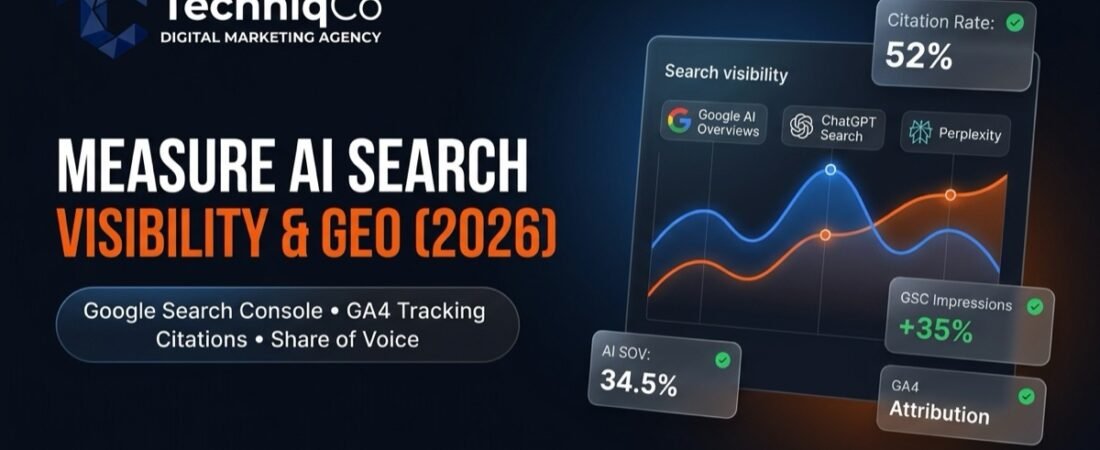
Example Calculation: If 26 out of those 50 test responses provide a clickable citation link back to your domain, your Source Citation Rate is (26 ÷ 50) × 100 = 52.0%.
3. AI Share of Voice (SOV)
Measures your brand presence relative to defined competitors within a fixed query category.
Unit Definition Guardrail: To maintain measurement integrity, define the unit consistently: decide whether you are counting unique brand appearances per response (binary: present or absent) or total brand mentions (frequency across the entire response). Whichever unit you choose, keep that definition fixed across all reporting periods to prevent skewed trendlines.
Example Calculation: Across 50 commercial evaluation prompts, your brand receives 38 mentions while three key competitors receive 32, 24, and 16 mentions respectively (total mentions = 110). Your AI Share of Voice is [38 ÷ (38 + 72)] × 100 = 34.5%.
4. AI Referral Conversion Rate
Evaluates commercial lead efficiency from visitors arriving via identified AI search channels.
Example Calculation: If GA4 records 49 qualified inquiries from 1,315 AI Assistant sessions, your conversion rate is (49 ÷ 1,315) × 100 = 3.73%.
Best AI Search Visibility Tracking Tools in 2026
A mature GEO tracking stack balances first-party server data with automated third-party query sampling. When evaluating tools, always identify whether the underlying data is first-party server data, simulated bot testing, or third-party statistical estimates:
| Tool / Platform | Primary Capability | Data Source Type | Best Used For | Limitations to Note |
|---|---|---|---|---|
| Google Search Console | Native Generative AI performance reporting | First-Party Official | Tracking Google AI Overview and AI Mode impressions and clicks | Does not track ChatGPT, Perplexity, or Claude |
| Google Analytics 4 | AI Assistant referral traffic and key event attribution | First-Party Official | Measuring actual landing page engagement and revenue pipeline | Cannot capture zero-click answers or stripped referrers |
| Semrush | SERP feature tracking and AI Overview presence | Simulated SERP Scraping | Monitoring keywords triggering AI Overviews across desktop and mobile | SERP estimates based on fixed scraping frequency |
| ZipTie.dev | Dedicated AI Overview and AI Mode citation monitoring | Simulated Query Scraping | Tracking exact URLs cited within Google AI Overviews across queries | Focused primarily on Google generative ecosystems |
| Profound / Peec AI | Multi-LLM brand mention and share-of-voice monitoring | Automated LLM API Sampling | Monitoring ChatGPT, Claude, and Perplexity brand sentiment and citations | API costs scale with prompt frequency; sampled queries |
| Standardized Prompt Log | Controlled internal benchmark testing in spreadsheets | Manual Controlled Empirical | SMB and agency custom auditing without software bloat | Labor intensive; an optional starting range is 50 to 200 queries |
How to Build a Monthly AI Search Visibility Report
An actionable monthly GEO report connects top-of-funnel exposure to bottom-line pipeline outcomes. Below is a practical reporting framework designed for executive reviews and marketing leadership:
Illustrative example only. The figures and test results below are hypothetical and do not represent verified TechniqCo performance.
| Reporting Category | Previous Month | Current Month | Change (Δ) | Executive Strategic Interpretation |
|---|---|---|---|---|
| GSC Generative AI Impressions | 18,400 | 24,900 | +35.3% | Expanded inclusion of technical SEO guides in Google AI Overviews |
| GA4 AI Referral Sessions | 815 | 1,315 | +61.3% | Strong traffic surge driven by ChatGPT and Perplexity citations |
| Brand Mention Rate (50 Prompts) | 64.0% | 76.0% | +12 percentage points | Growing brand recall in commercial Delhi NCR agency queries |
| Source Citation Rate (50 Prompts) | 44.0% | 52.0% | +8 percentage points | More articles cited as direct reference sources for automation |
| AI Share of Voice (vs 3 Competitors) | 28.5% | 34.5% | +6 percentage points | Outperformed Competitor B in automation and video SEO topics |
| Attributed Qualified Leads | 28 | 49 | +75.0% | Higher intent visitors converting via dedicated service landing pages |
Distinguishing Correlation From Causation
When reporting monthly numbers, avoid attributing every increase in organic traffic or brand inquiries solely to GEO. Search traffic is influenced by seasonal demand, ongoing traditional SEO improvements, algorithm updates, and off-page mentions. Establish clear operational decision rules: investigate declines only when a metric drops across at least two consecutive monthly reporting cycles rather than reacting hastily to short-term model fluctuations.
Architectural Distinction: Google Systems vs Standalone LLMs: A critical distinction must be maintained when interpreting visibility shifts. Google Search systems (including AI Overviews and AI Mode) operate on web indexing, crawling infrastructure, and search ranking signals. In contrast, standalone LLMs (such as ChatGPT search and Perplexity) employ distinct retrieval-augmented generation (RAG) architectures, web search APIs, and synthetic reasoning pipelines. What influences visibility in Google Search should not be generalized as a universal rule for third-party conversational AI platforms.
Common AI Search Measurement Mistakes
Marketing teams frequently misinterpret AI search performance due to flawed measurement setups. Avoid these nine common traps:
- Treating a Single Response as Universal Proof: A single prompt test that cites your brand does not mean millions of searchers see the same result. AI outputs vary by user prompt history, device, and real-time retrieval parameters.
- Confusing Brand Mentions With Website Citations: Being named in a paragraph does not guarantee that a clickable source link was provided to drive direct traffic to your site.
- Assuming All AI Referrals Appear in Analytics: In-app browser clicks and stripped HTTP referrers frequently slip into direct traffic. Always cross-reference direct traffic surges with AI mention trends.
- Comparing Inconsistent Prompt Sets Across Periods: Changing prompt wording between Month 1 and Month 2 invalidates longitudinal tracking. Keep your evaluation prompts identical across test cycles.
- Treating Third-Party Estimates as Official Data: Third-party scraping tools estimate visibility using sampled bots. While valuable for competitive benchmarking, they do not have private API access to proprietary platform usage logs.
- Focusing on Vanity Visibility Without Measuring Pipeline: Earning thousands of AI Overview impressions generates zero enterprise value if those impressions do not translate into qualified leads and revenue.
- Ignoring Query Intent Behind Mentions: Being cited for elementary definitions is less valuable than being recommended in high-intent commercial decision queries. Segment informational queries from commercial queries.
- Generalizing Google Rules to All AI Engines: Core Google Search crawling and snippet controls do not directly govern how independent LLMs index or retrieve third-party data.
- Reporting Rates Without Stating the Denominator: Stating an “80% citation rate” is meaningless unless you disclose the denominator (for example, “80% citation rate across 50 tested commercial queries in Delhi NCR”).
How to Improve AI Search Visibility After Measuring It
Measurement creates value only when it drives concrete optimization. Once you identify visibility gaps across specific platforms or topic clusters, implement these six data-backed actions:
1. Reformat Content for Direct Machine Ingestion
LLMs favor content structured for unambiguous entity extraction. Place direct answers within the first 60 words under descriptive H2 headings. Use structured definition lists, numerical steps, and comprehensive HTML comparison tables that RAG systems can easily parse.
2. Expand Multimodal Video Assets
AI search engines increasingly cite video explainers and step-by-step video timestamps. Ensure your video assets include accurate transcripts and valid VideoObject schema. For implementation blueprints, explore TechniqCo’s guide on optimizing AI-generated videos for SEO and AI search.
3. Strengthen First-Party Brand Authority
Generative models cross-reference third-party review directories, Wikipedia, industry roundups, and authoritative press coverage. If your brand is missing from key industry directories, prioritize digital PR to build external verification signals that LLMs trust.
4. Automate Content Production Pipelines
Scaling topical authority across dozens of specialized queries requires consistent editorial throughput. Discover how automated workflows streamline distribution in our breakdown of AI video automation workflows in 2026 and our tutorial on n8n YouTube Shorts automation.
5. Optimize Core Technical SEO Foundations
Generative engines cannot cite pages that web crawlers cannot index. Maintain clean site architecture, fast Core Web Vitals, and mobile responsiveness. Learn more about foundational services on TechniqCo’s dedicated search engine optimization page.
6. Align Inbound AI Traffic With Conversion Architecture
Ensure that cited URLs feature direct call-to-action pathways and clear lead capture forms. Review TechniqCo’s specialized frameworks for B2B lead generation and custom website development to maximize conversion rates.
Key Takeaways for Measuring AI Search Visibility in 2026
- Blend First-Party and Empirical Data: Combine verified Google Search Console Generative AI impressions and GA4 referral traffic with disciplined, repeatable prompt testing across third-party LLMs.
- Maintain Fixed Evaluation Sets: Keep prompt text, query collections, model versions, and testing cadence strictly identical across reporting months to ensure valid longitudinal analysis.
- Tie Visibility to Business Value: Avoid reporting brand mentions in isolation. Track downstream engagement, key conversion events, and pipeline revenue to evaluate true commercial return.
- Respect Platform Distinctions: Recognize that Google Search indexing signals differ fundamentally from standalone LLM retrieval systems. Optimize for both without conflating their underlying architectures.
Frequently Asked Questions
1. How do I measure AI search visibility?
You measure AI search visibility by combining Google Search Console Generative AI impression reports, GA4 AI Assistant referral metrics, standardized prompt-testing logs across target query sets, and downstream lead tracking. This provides both verified reach and qualitative brand sentiment.
2. Can Google Search Console track AI Overviews?
Yes. Use Google’s documented Generative AI performance report to monitor impressions, clicks, pages, and available geographic or device breakdowns. Consult current reporting definitions when interpreting impressions.
3. How can I measure visibility in ChatGPT search?
You measure ChatGPT search by monitoring referral sessions from chatgpt.com in GA4 and maintaining a fixed prompt-testing log to track whether your brand is mentioned and whether clickable source citations are provided for commercial and informational queries.
4. What is the difference between GEO and SEO metrics?
Traditional SEO metrics measure keyword ranking positions, click-through rates, and indexation across search result pages. GEO metrics measure generative answer impressions, brand mention frequency in synthesized paragraphs, source citation rates, and AI platform referral volume.
5. How do I track citations from AI-generated answers?
Track citations by testing a consistent set of prompts monthly, recording which responses display your website URL in source chips or footnotes, and cross-referencing landing page referral sessions inside Google Analytics 4.
6. Which tools can measure AI search visibility?
Primary tools include Google Search Console (for native Google impressions), Google Analytics 4 (for referral traffic and conversions), specialized tracking platforms like ZipTie.dev, Semrush, and Profound, alongside custom spreadsheet prompt logs.
7. How often should businesses measure GEO performance?
Review first-party GSC impressions and GA4 referral traffic bi-weekly. Execute comprehensive prompt sampling, brand mention auditing, and competitor share-of-voice reporting on a monthly cadence to avoid overreacting to short-term model variations.
8. Can AI search visibility generate qualified leads?
While visitors arriving via AI search citations can exhibit high commercial intent if the AI has synthesized preliminary research, conversion quality should always be measured using GA4 key events and CRM pipeline data rather than assumed.
9. Is there a universal AI visibility score?
No. There is no official cross-platform AI visibility score. Scores published by third-party software are proprietary estimates based on their specific prompt samples and should be treated as directional benchmarks rather than universal truths.
10. Can Google Analytics identify all AI search traffic?
No. GA4 captures traffic where HTTP referrer headers are preserved. Visits from mobile apps or privacy browsers often have stripped referrers and appear as direct traffic, while Google AI Overview clicks remain categorized under organic search.
Need an Actionable AI Search Visibility Audit for Your Business?
TechniqCo can help assess your organic search visibility, technical SEO foundations, content architecture, and conversion tracking to identify practical opportunities for growth across Google, AI Overviews, and conversational search platforms.
Get an AI Search Visibility Audit →About Trivender Singh
Trivender Singh is the Co-Founder at TechniqCo, specializing in Generative Engine Optimization (GEO), Answer Engine Optimization (AEO), technical SEO, and data-driven digital marketing strategies. He works with businesses to design clear search measurement frameworks and organic growth pipelines. Connect on LinkedIn.
Related posts:
 ChatGPT Ads Measurement Tools and Visual Ad Formats in 2026: Performance Marketing Guide
 The Advanced AI Prompt Playbook: ChatGPT Prompts for SEO, GEO, and AEO in 2026
 How to Get Your Brand Cited in ChatGPT Search, Perplexity & Google Gemini in 2026: The Complete GEO Blueprint
 Gemini 4 Argon vs GPT vs Claude: What Businesses Should Know in 2026
 How to Find Trending Keywords Before Your Competitors in 2026
 Google Demand Gen September 2026: Business Agent, YouTube Ads & AI Updates