When you search for competitive keywords on Google, established websites with high domain authority almost always claim top rankings. But what exactly is domain rating, how is it calculated, and how can you increase your score?
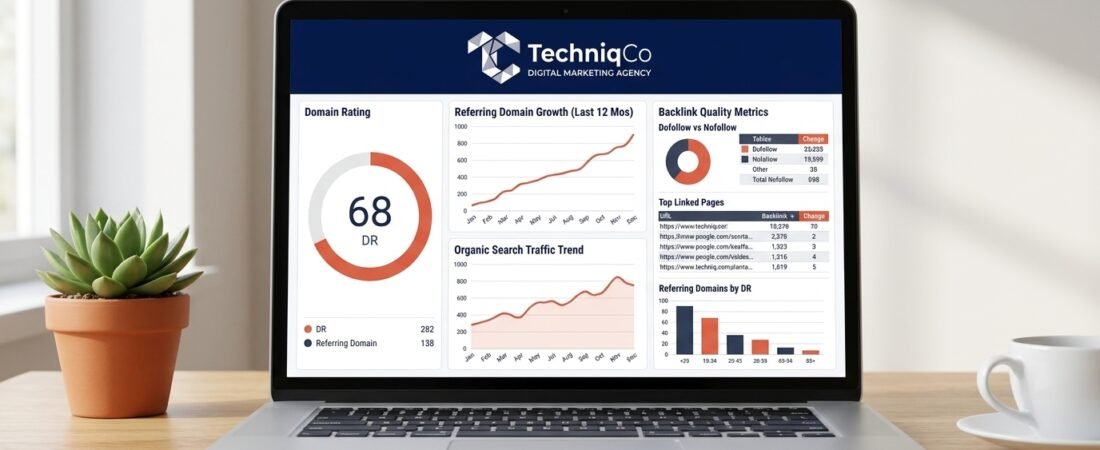
Domain Rating (DR) is a metric created by SEO software companies to measure the strength of a website’s backlink profile. The higher your score, the easier it is to rank new pages on search engine result pages.
In this guide, you will learn what domain rating means, how it impacts your search rankings, and five proven strategies to increase your score in 2026.
What Is Domain Rating (DR) vs. Domain Authority (DA)?
Domain Rating measures the relative strength of a website’s backlink profile on a logarithmic scale from 0 to 100.
Different SEO tools use slightly different names for this authority metric:
| Metric Name | SEO Tool | Primary Calculation Focus | Scale |
|---|---|---|---|
| Domain Rating (DR) | Ahrefs | Quantity and quality of unique linking domains | 0 to 100 |
| Domain Authority (DA) | Moz | Backlink profile strength and search index history | 0 to 100 |
| Authority Score (AS) | SEMrush | Backlinks, organic traffic, and spam signals | 0 to 100 |
Although Google does not officially use “Domain Rating” as a direct ranking factor, search engines rely heavily on PageRank. PageRank evaluates link quality and trust across the web. Consequently, a higher Domain Rating correlates strongly with higher search rankings.
To learn how domain authority fits into a complete search engine strategy, explore our specialized SEO and digital marketing services.
How Is Domain Rating Calculated?
Domain Rating algorithms calculate your score based on three core link factors:
- Unique Referring Domains: Earning links from 100 different websites increases your score much more than receiving 100 links from a single domain.
- The DR Score of Linking Sites: A backlink from a high-DR website (e.g., DR 80+) passes significantly more authority than a link from a brand-new blog (DR 10).
- Number of Outbound Links: If a high-authority site links to hundreds of other websites, the authority passed to your page is divided among those links.
Therefore, building links from respected websites that link out selectively gives you the biggest score boost.
What Is a Good Domain Rating Score?
There is no single “good” DR score. Instead, your score is relative to your specific industry competitors:
| DR Score Range | Website Status | Typical Search Performance |
|---|---|---|
| 0 – 20 | Brand new websites | Ranks mainly for low-competition long-tail keywords |
| 21 – 40 | Growing small business sites | Ranks for moderate local search queries |
| 41 – 60 | Established industry brands | Ranks consistently on page one for commercial terms |
| 61 – 80+ | Enterprise & major news media | Dominates high-volume competitive keywords |
Rather than aiming for a generic score of 70+, focus on outranking your immediate business competitors.
5 Proven Ways to Increase Your Domain Rating in 2026
Improving your Domain Rating requires acquiring high-quality backlinks systematically over time. Follow these five strategies to build sustainable website authority:
1. Create Linkable Content Assets
Websites link out to resources that provide unique value. Therefore, publish original research, industry data benchmarks, step-by-step guides, and free tools.
For instance, publishing a detailed guide on how to do a website audit attracts editorial links naturally from other marketing blogs.
2. Practice Strategic Guest Blogging
Contribute high-quality articles to reputable publications in your industry. In return, place a contextual link back to an informational resource on your domain.
Avoid low-quality guest post networks that sell links in bulk. Instead, target real websites with active traffic and engaged readers.
3. Reclaim Lost and Unlinked Brand Mentions
Use tools like Ahrefs or Google Alerts to find websites mentioning your company name without linking back to you. Next, send a polite email thanking them for the mention and requesting a link back to your homepage.
Additionally, monitor broken internal links and 404 pages across your domain so incoming link equity is not lost.
4. Build Digital PR Campaigns
Digital PR involves pitching compelling stories, expert commentary, and data insights to online journalists and news publications. A single mention in a major publication can boost your DR score by several points.
To learn how search engines evaluate brand citations, read our guide on SEO, GEO, and AEO search strategies.
5. Audit and Disavow Spammy Backlinks
Low-quality backlinks from spammy directories or hacked websites erode your site trust. Regularly audit your link profile and disavow toxic links via Google Search Console.
If you operate a local business, pair authority link building with a optimized Google Business Profile setup to dominate local search results.
Common Domain Rating Myths to Avoid
- Myth 1: Higher DR Automatically Guarantees #1 Rankings.
Fact: A site with DR 30 can easily outrank a DR 60 site if its page content matches search intent more accurately. - Myth 2: Buying Bulk Links Boosts DR Safely.
Fact: Search algorithms detect unnatural link velocity quickly. Buying cheap links often leads to manual penalties. - Myth 3: Nofollow Links Increase DR.
Fact: Most authority algorithms count only dofollow links toward your DR score. However, nofollow links still drive valuable referral traffic.
Boost Your Domain Authority with TechniqCo
Building website authority requires consistent outreach, technical precision, and high-quality content execution.
At TechniqCo, we help Indian startups and SMBs build sustainable link authority, fix technical SEO errors, and rank higher for commercial search queries.
Related Resources:
- How to Do a Complete Website Audit
- The SEO, GEO & AEO Checklist for 2026
- Google Business Profile Optimization Guide
Ready to increase your domain authority and search traffic? Book a free strategy consultation with TechniqCo today!
Related posts:
 Link Building for Indian Startups: 10 Strategies to Get High-Authority Backlinks Without an Agency
 How to Do a Website Audit: A Complete Step-by-Step Guide for 2026
 The Ultimate On-Page SEO Checklist 2026: 47 Points to Rank #1 on Google
 How to Optimize Your Google Business Profile: The Complete 2026 Guide for Local Visibility
 SEO for Travel Website: How To Generate Quality Leads Through Website Traffic
 What Is SEO And How It Is Creating Trillion Dollar Industry By Increasing Website Traffic