
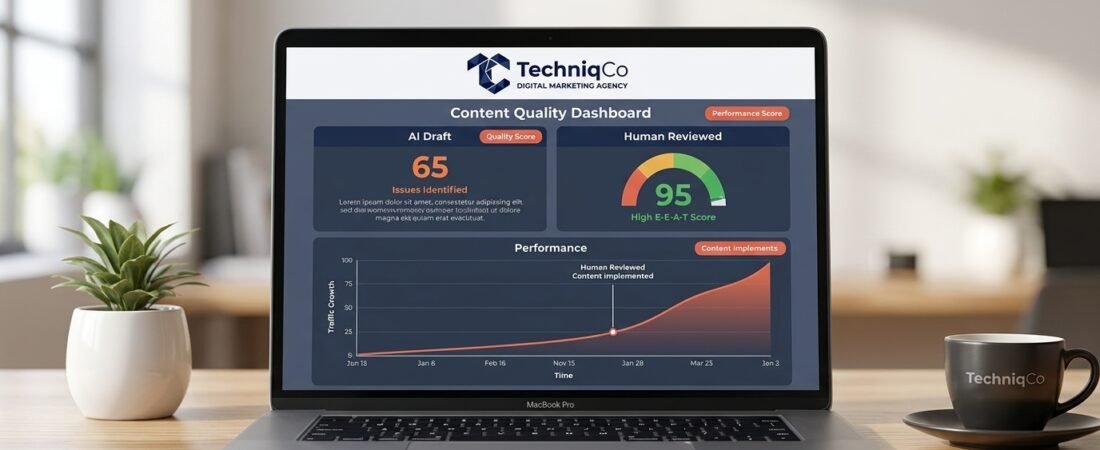
Artificial intelligence writing tools have flooded the content marketing industry. Thousands of bloggers, agencies, and businesses now produce articles in minutes rather than days. However, a critical question remains: does Google reward AI-generated content, human-written content, or a combination of both?
The answer directly affects your search rankings, organic traffic, and business revenue.
In this article, we break down the real difference between AI-generated and human-written content, explain what Google’s algorithm actually rewards in 2026, and share the exact content approach that consistently ranks and converts.
What Is the Actual Difference Between AI and Human Content?
Before analyzing Google’s preferences, you need to understand what separates these two content types.
AI-generated content is produced by large language models (LLMs) like ChatGPT, Gemini, or Claude. These models predict statistically probable text sequences based on training data. As a result, AI produces grammatically correct, logically structured, and topically relevant text at speed.
Human-written content, however, draws from personal experience, original research, professional judgment, and authentic emotion. Consequently, it carries something AI fundamentally cannot replicate — genuine expertise and lived perspective.
The distinction matters more than ever for SEO. To understand how content strategy integrates with broader search visibility, explore our complete search engine optimization services.
What Does Google Actually Say About AI Content?
Google’s position on AI content has evolved significantly. Here is what their official guidance states in 2026:
Google does not ban AI content. Instead, Google’s Search Essentials and Helpful Content guidelines evaluate content on one core principle:
“Our focus is on the quality of the content, not how it was produced.”
However, Google simultaneously enforces its E-E-A-T framework (Experience, Expertise, Authoritativeness, and Trustworthiness) as the primary quality signal. This is where pure AI content consistently falls short.
Understanding Google’s E-E-A-T Framework
E-E-A-T is not a direct ranking algorithm. Rather, it is the framework Google’s quality raters use to evaluate whether content genuinely serves the user.
Each element matters for ranking:
| E-E-A-T Signal | What It Means | Why AI Struggles |
|---|---|---|
| Experience | Content reflects real, first-hand use or testing | AI has no lived experience |
| Expertise | Content demonstrates deep subject knowledge | AI rehashes existing training data |
| Authoritativeness | The author/site is recognized as a credible source | AI has no verifiable professional identity |
| Trustworthiness | Content is accurate, honest, and citable | AI frequently hallucinates facts |
Therefore, content that lacks these signals — regardless of how it was produced — loses ground in competitive search rankings.
Why Pure AI Content Underperforms in 2026
Many businesses tried publishing bulk AI content in 2023 and 2024. Initially, some pages ranked. However, as Google’s Helpful Content updates matured, sites relying entirely on AI-generated articles experienced significant traffic declines.
Here is why pure AI content consistently underperforms:
1. Lack of Original Insights
AI models are trained on existing public data. As a result, they produce content that summarizes what is already widely available online. Google specifically penalizes content that “doesn’t add substantial value compared to other pages in search results.”
2. Missing First-Hand Experience
When someone searches for “best SEO tools for Indian startups,” they want advice from someone who has tested those tools. AI cannot test tools, visit locations, interview experts, or document original case studies. Consequently, AI-only articles lack the experiential depth that users and Google reward.
3. Factual Hallucinations
AI models frequently generate plausible-sounding but factually incorrect statistics, quotes, and references. Publishing inaccurate content damages your brand’s trustworthiness and can trigger manual quality reviews.
4. Predictable Patterns That Crawlers Detect
Google’s spam classifiers have grown sophisticated at identifying AI-generated patterns. Repetitive sentence structures, generic introductions, and formulaic conclusions all reduce content quality scores internally.
Why Human Content Still Wins for Competitive Rankings
For competitive, high-intent keywords — the exact queries that drive real business leads — human-written content consistently outperforms pure AI output.
Here is what human content provides that AI cannot:
- Original perspectives and opinions that position your brand as a thought leader
- Personal case studies and client results that demonstrate real-world expertise
- Brand voice consistency that builds a loyal readership over time
- Verifiable author credentials that strengthen E-E-A-T signals
- Dynamic local and cultural context relevant to specific markets like India
For example, our detailed guide on how to do a website audit performs well precisely because it reflects genuine technical experience, not a generic industry summary.
The Winning Formula: AI-Assisted, Human-Led Content
In 2026, the highest-ranking content teams do not choose between AI and humans. Instead, they combine both in a structured workflow.
Here is the proven hybrid content process:
Step 1 — AI for Research and Structure
Use AI tools to rapidly analyze competitor articles, identify content gaps, generate keyword clusters, and produce an initial structural outline. This saves hours of manual research.
Step 2 — Human Expert Drafting
A subject-matter expert writes the body content from scratch, using the AI outline as a framework. They inject personal experience, original examples, verified data, and brand-specific insights.
Step 3 — AI-Assisted Editing
Run the human draft through AI grammar and readability tools (like Grammarly or Hemingway Editor) to tighten sentence structure, improve readability scores, and check for passive voice overuse.
Step 4 — Plagiarism and Originality Check
Before publishing, run the final draft through Copyscape or Quetext to verify 100% originality. Remove any sentence patterns that mirror top-ranking competitor content too closely.
Step 5 — Human Final Review
A senior editor approves the final article, verifying factual accuracy, brand voice alignment, internal link quality, and E-E-A-T signal strength.
This exact approach is what we use at TechniqCo for every piece of content. To see the results of this workflow, browse our digital marketing blog.
How to Identify AI Content That Harms Your Rankings
If your existing blog contains AI-generated content, audit it for these warning signals:
- Generic openings: Phrases like “In today’s fast-paced digital landscape…” or “In the ever-evolving world of marketing…”
- Unsourced statistics: Specific percentages or figures with no verifiable citation
- Repetitive paragraph structure: Every paragraph following the identical sentence pattern
- Zero unique examples: Content that uses only abstract hypothetical scenarios rather than real-world applications
- No author attribution: Articles without a named author identity
Pages with multiple warning signals should be updated with human expertise before they drag down your entire domain’s quality rating.
What Content Strategy Should You Use in 2026?
Based on Google’s guidelines and real-world ranking data, here is the clear answer:
Use AI as your research and editing assistant. Use human expertise as your content engine.
Specifically:
- For educational top-of-funnel content: Use the hybrid AI + human approach for scale.
- For commercial service pages: Write these entirely by hand with genuine expertise and client evidence.
- For technical how-to guides: Combine AI structure with human practical experience.
- For opinion and thought leadership pieces: Write these 100% by hand for maximum E-E-A-T impact.
For a complete breakdown of how content strategy connects to search authority, read our guide on increasing your website’s domain rating.
Build a High-Ranking Content Strategy with TechniqCo
At TechniqCo, every article we produce follows a strict hybrid content process — AI-assisted research, human expert drafting, plagiarism verification, and editorial quality review. This approach consistently delivers articles that rank, convert, and build long-term brand authority.
Related Reading:
- How to Do a Complete Website Audit
- SEO, GEO & AEO: Dominating Search in the AI Era
- How AI is Transforming Digital Marketing in India
Ready to publish content that genuinely ranks and resonates? Book a free content strategy consultation with TechniqCo today.
Related posts:
 The Ultimate On-Page SEO Checklist 2026: 47 Points to Rank #1 on Google
 SEO for Travel Website: How To Generate Quality Leads Through Website Traffic
 Link Building for Indian Startups: 10 Strategies to Get High-Authority Backlinks Without an Agency
 How to Optimize Your Google Business Profile: The Complete 2026 Guide for Local Visibility
 How to Do a Website Audit: A Complete Step-by-Step Guide for 2026
 What Is SEO And How It Is Creating Trillion Dollar Industry By Increasing Website Traffic