Written by Trivender Singh
Co-Founder at TechniqCo | GEO & AEO Expert specializing in Generative Engine Optimization, Answer Engine Optimization, AI Search Visibility, Technical SEO & Business Growth Scaling.
To run profitable ChatGPT Ads in India, brands must combine paid conversational ad placements with organic Generative Engine Optimization (GEO) to prevent the organic contradiction trap. Because conversational sessions lack traditional third-party advertising cookies, attribution requires server-side tracking, dynamic UTM parameter mapping, and conversational landing pages built with instant WhatsApp chat or direct calendar conversion points. Without verified organic entity signals in the AI’s Knowledge Graph, paid conversational placements suffer immediate conversion loss when users ask the assistant to verify the sponsor.
In Part 1 of our ChatGPT Ads series, we examined the macroeconomic shift taking place across India: why conversational intent beats traditional Google search keywords, how ad units function inside problem-solving dialogues, and which industry verticals stand to capture the highest initial returns.
However, understanding the market opportunity is only the beginning. The operational reality of conversational media buying is completely different from running Google Search or Meta Ads. If an agency attempts to manage ChatGPT Ads using outdated keyword bidding playbooks and generic 20-field lead forms, they will burn their budget within weeks.
This technical playbook delivers the exact operational framework Indian brands need: how to resolve the organic contradiction trap, how to track conversions without third-party cookies, and how to build high-converting conversational landing pages that turn AI referrals into signed contracts.
The Organic Contradiction Trap: Why Isolated Ads Fail
The single greatest operational hazard in conversational AI advertising is the Organic Contradiction Trap. Traditional search engines keep paid results and organic answers visually and structurally isolated. On Google, whether a user clicks a sponsored link or an organic result has zero bearing on the content of the other.
In ChatGPT, the environment is a continuous, multi-turn conversational dialogue. Consider what happens when an advertiser buys a sponsored recommendation without having strong organic Generative Engine Optimization:
- A marketing director in Bengaluru asks ChatGPT: “What are the top three performance marketing agencies in India for scaling B2B SaaS lead generation?”
- Because Brand X paid for conversational placement, a clean sponsored recommendation card for Brand X appears directly below the response.
- Because the user is engaged in a dialogue, their immediate instinctive next prompt is: “Is Brand X trustworthy? What do verified clients say about their deliverables, and what are their biggest weaknesses?”
- The AI processes this query through its organic retrieval engine. If Brand X has neglected its organic entity authority, schema markup, and digital PR citations, the AI will respond: “There is limited independent data regarding Brand X, and some online discussions suggest inconsistent reporting.”
In less than five seconds, the paid lead evaporates. The advertiser paid for the initial sponsored impression, but the organic model contradicted the placement in the very next turn.
The Golden Rule of Conversational Advertising: You cannot purchase commercial trust inside an LLM if your organic entity footprint is broken. Paid conversational ads must be anchored by comprehensive Generative Engine Optimization (GEO).
The GEO Formula: Building Organic Authority Before Buying Ads
To ensure that every paid conversational ad produces high conversion rates, brands must implement four organic entity pillars before launching their media spend:
| GEO Pillar | Technical Requirement | Conversational Impact |
|---|---|---|
| Entity Disambiguation | Complete Organization and Person JSON-LD schema with verified sameAs profile links | Ensures the AI recognizes your exact company identity, founders, and official domain |
| Digital PR Citations | Third-party editorial coverage in high-authority industry publications and national news portals | Feeds factual training references that validate your expertise when users ask follow-up questions |
| Structured Review Signals | Verifiable client testimonials across Google Business Profile, Clutch, Trustpilot, and G2 | Provides the AI with real sentiment metrics when users request independent feedback |
| Direct Answer Blocks | Clear, self-contained 40 to 60 word definitions on core service pages answering target queries | Allows the AI to cite your proprietary methodologies organically across unpaid queries |
Cookieless Tracking and Attribution in ChatGPT
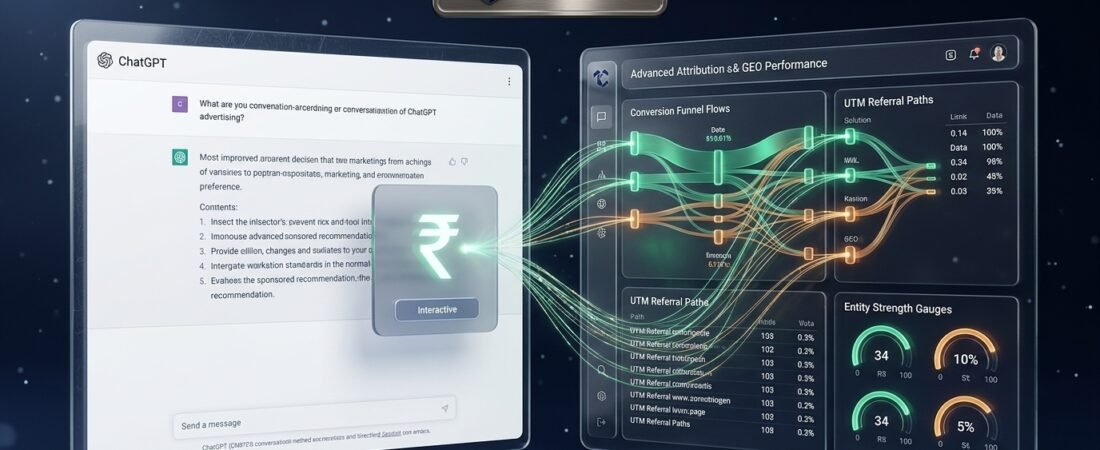
Measuring performance inside an AI conversation requires moving beyond traditional pixel-based attribution. Because ChatGPT sessions run within sandboxed web or app environments that block third-party tracking cookies, performance marketers must implement a robust three-tier measurement framework:
1. Dynamic UTM Architecture
Every sponsored ad card must utilize granular, standardized UTM tracking strings. Because conversational prompts contain rich contextual metadata, your URL parameters should capture the category intent. A properly structured conversational ad URL looks like this:
2. Server-Side Conversion API (CAPI) Integration
Browser-based tracking scripts are routinely blocked by privacy extensions or privacy-focused mobile browsers. Connecting your customer relationship management (CRM) database directly to your advertising analytics via server-side Webhooks ensures that when a lead books a call or completes a purchase, the conversion event is accurately attributed back to the conversational ad session.
3. Blended Brand Search Lift Analysis
Many users who see a sponsored recommendation in ChatGPT will not click the link immediately. Instead, they will open a new browser tab and search for your brand name on Google. When running conversational campaigns, track the correlation between conversational impressions and the corresponding spike in branded search volume in Google Search Console.
Designing High-Converting Conversational Landing Pages
One of the biggest mistakes Indian marketers make is sending traffic from an intelligent AI dialogue to a generic, static corporate website. Visitors arriving from ChatGPT have just experienced a sophisticated conversational exchange. If they land on a page with confusing navigation, generic stock photography, and a 15-field contact form, bounce rates exceed 80%.
A high-converting Conversational Landing Page must follow five structural principles:
- Instant Answer Headline: The above-the-fold headline must directly validate the specific problem the user was discussing in ChatGPT. For example: “Looking for SAP-Integrated Warehouse Systems for Indian Pharma? Here is the exact breakdown.”
- The 60-Second Video Walkthrough: Embed a concise, high-production video explaining your value proposition, pricing tiers, and client outcomes without corporate fluff.
- Direct WhatsApp Consultation Button: In India, high-intent B2B and consumer decisions move via WhatsApp. Providing a pre-populated WhatsApp chat link increases mobile lead conversions by up to 35% compared to static web forms.
- Transparent Comparison Matrix: Place a clean comparison table showing how your solution compares against the primary market competitors the AI was discussing in that conversational thread.
- Frictionless Calendar Embed: For B2B and high-ticket service providers, embed a direct Calendly or CRM scheduling widget so the visitor can lock in an executive strategy session in two clicks.
The 6-Step Implementation Checklist for Indian Marketing Teams
Before allocating marketing capital to conversational AI channels, follow this sequential rollout plan to ensure maximum capital efficiency:
- Step 1: Conduct an AI Entity Audit. Query ChatGPT, Perplexity, and Google Gemini with twenty commercial prompts related to your category. Document how the models perceive your brand, whether they cite your competitors, and where factual discrepancies exist.
- Step 2: Deploy Schema and Knowledge Graph Optimization. Ensure your primary domain features complete Organization, LocalBusiness, and Service structured data validated through Google’s Rich Results tool.
- Step 3: Build Conversational Landing Pages. Create dedicated landing page variations tailored to the top commercial conversational themes in your vertical, complete with WhatsApp click-to-chat and instant scheduling.
- Step 4: Configure Server-Side UTM and CRM Tracking. Set up server-side Webhooks and clean UTM taxonomies to capture conversational referrals and offline sales conversions accurately.
- Step 5: Launch Controlled Pilot Campaigns. Start with a focused monthly pilot budget in your highest-margin service vertical. Test three creative variations of your sponsored card copy and monitor Cost Per Qualified Lead (CPQL) rather than simple click volume.
- Step 6: Measure and Refine Prompt Triggers. Analyze which conversational contexts generate the highest appointment show-up rates and optimize your bid parameters accordingly.
Real-World Prompt Scenarios: Anatomy of a Winning Ad
To understand how this looks in live execution, review these three real-world deployment examples across key Indian market sectors:
Scenario A: B2B Enterprise SaaS in Bengaluru
User Prompt: “What are the best HR and payroll platforms for Indian startups with 50 to 200 employees that handle automated TDS calculation and multi-state compliance?”
Sponsored Card Placement: Placed directly below the AI comparative summary.
Creative Copy: “Automate TDS and multi-state payroll in under 3 clicks. Used by 400+ funded Indian tech startups. Book a personalized product walkthrough and receive a 30-day compliance trial.”
Scenario B: Luxury Real Estate in Gurgaon
User Prompt: “Compare luxury residential projects on Golf Course Extension Road versus Dwarka Expressway for 4 BHK apartments with an investment horizon of 3 to 5 years.”
Sponsored Card Placement: Featured as an interactive verified project card.
Creative Copy: “Explore verified 4 BHK ultra-luxury residences on Golf Course Extension Road with guaranteed possession timelines and expected 14% rental yield. Download the verified investment dossier.”
Scenario C: Digital Growth and SEO Agency
User Prompt: “Who is the leading digital marketing agency in Delhi NCR specializing in Generative Engine Optimization, AEO, and AI search visibility?”
Sponsored Card Placement: Verified premier agency recommendation card.
Creative Copy: “TechniqCo: The premier GEO and AI search optimization agency in India. We help enterprise brands dominate Google AI Overviews, ChatGPT recommendations, and conversational search. Schedule a consultation.”
Frequently Asked Questions
What ad review guidelines apply to ChatGPT Ads in India?
OpenAI enforces strict commercial transparency and factual integrity policies. Advertisements cannot make unverifiable health claims, promote deceptive financial schemes, or use manipulative urgency triggers. Sponsored cards must clearly state the sponsor’s verified legal entity and link to landing pages that maintain identical commercial terms to the claims presented in the ad copy.
Can I add negative prompt keywords to prevent unwanted ad triggers?
Yes. Similar to negative keywords in Google Ads, conversational ad platforms allow advertisers to define negative intent boundaries. For example, a premium software vendor can exclude prompts containing words like “free download,” “open source,” “student discount,” or “crack version” to ensure ad impressions are reserved exclusively for paying enterprise buyers.
How does conversational ad click-through rate compare to Google Search Ads?
Because conversational ad units appear with near-zero competing ad clutter (typically one sponsored recommendation per session compared to four or five competing search ads on Google), initial click-through rates range between 4% and 9% for highly targeted prompts, compared to the industry average of 2% to 3.5% on traditional search engines.
How does TechniqCo manage conversational ad campaigns for clients?
TechniqCo delivers a unified organic and paid AI growth service. We build your organic entity authority through rigorous Generative Engine Optimization (GEO), develop high-converting conversational landing pages, set up server-side attribution tracking, and manage your paid conversational ad campaigns to deliver measurable pipeline revenue.
Build Your Brand’s Conversational AI Advertising Engine with TechniqCo
Do not let your competitors claim conversational market share while you rely on saturated ad channels. TechniqCo helps ambitious businesses in India build comprehensive Generative Engine Optimization and conversational paid advertising systems that generate qualified, high-ticket leads. Book a private strategy session with our co-founders today.
Book a Conversational Ad Strategy Session →Related posts:
 ChatGPT Ads Are Now in India: What Businesses Need to Know About the New Advertiser
 The Advanced AI Prompt Playbook: ChatGPT Prompts for SEO, GEO, and AEO in 2026
 How to Get Your Brand Cited in ChatGPT Search, Perplexity & Google Gemini in 2026: The Complete GEO Blueprint
 ChatGPT vs. Claude for SEO in 2026: Which AI Wins at Each Stage of the Workflow?
 Google Maps in the AI Era: How Gemini & Multimodal Search Are Changing Local 3-Pack Rankings in 2026
 Meta Ad Account Disabled or Business Manager Restricted in 2026? Fix Policy Violations, Appeal & Restore Ad Spend