
Written by Trivender Singh
Co-Founder at TechniqCo | GEO & AEO Expert specializing in Generative Engine Optimization, Answer Engine Optimization, AI Search Visibility, Technical SEO & Business Growth Scaling.
Category: Local Search, Event Marketing, SEO, Generative Engine Optimization
Primary Focus Keyword: Dandiya events Delhi 2026
Key Focus Topics: Dandiya events Delhi, Navratri events Delhi 2026, Google Business Profile, Event structured data, Generative Engine Optimization, Google Maps
To be discovered across Google Search, Google Maps, Apple Maps, and AI answer engines (such as Gemini, ChatGPT, and Perplexity) for multi-constraint queries during Navratri 2026, event organizers must publish all operational facts (exact calendar dates, verified venue address with landmarks, entry start and curfew times, pass pricing, parking capacity, age/family policies, and official booking URLs) as crawlable HTML text on an authoritative canonical landing page, validated with Schema.org Event structured data and synchronized across ticketing portals and Google Business Profile surfaces.
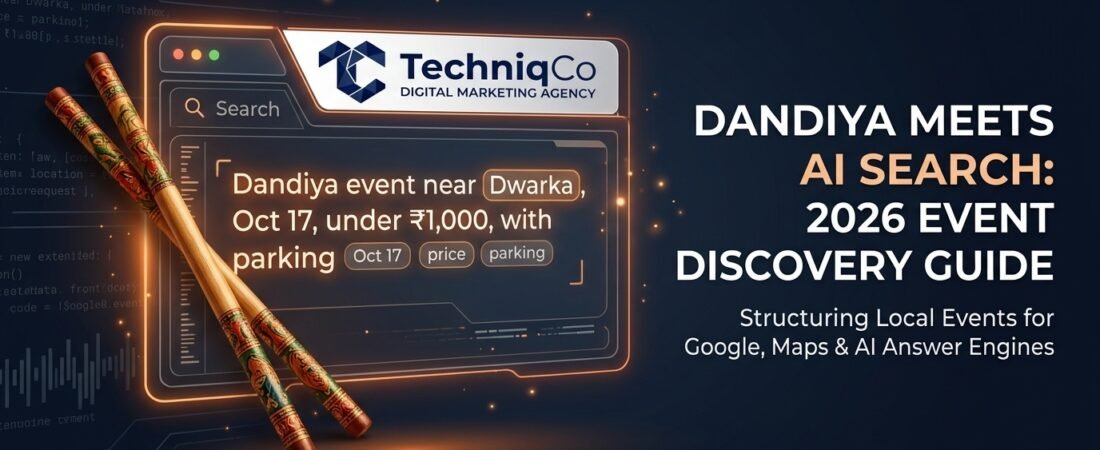
Consider a consumer searching on a mobile device in West Delhi during mid-October 2026:
“Find me a Dandiya event near Dwarka on October 17 under ₹1,000, with parking and family-friendly entry.”
This is not a traditional keyword search. The user did not type dandiya delhi or garba passes dwarka. Instead, they submitted a six-variable constraint query:
1. Specific activity: Dandiya / Garba
2. Geographic radius: Near Dwarka
3. Exact date: Saturday, October 17, 2026 (Day 7 / Saptami of Sharad Navratri)
4. Price threshold: Under ₹1,000
5. Amenity requirement: Dedicated vehicle parking
6. Audience policy: Family-friendly entry
Whether that query is processed by Google Search, Google Maps, an AI-assisted search mode, or a conversational assistant like ChatGPT or Perplexity, the underlying discovery mechanism has evolved.
In 2026, discovery is no longer about matching a single keyword string on an unstructured web page. Discovery increasingly depends on whether an event’s essential information is accessible, clear, current and understandable across the digital ecosystem.
If an organizer published ticket prices on Instagram, venue details on BookMyShow, parking rules nowhere, and left the event date buried in a flyer graphic, that event is invisible to multi-constraint queries.
This guide provides an evidence-based analysis of how event organizers, venue managers, and local marketers can structure their digital presence for Navratri 2026 and beyond.
⚡ If You Only Do 5 Things Before Navratri
- Create an official event page on your own domain to serve as your authoritative primary source.
- Publish every important detail as indexable text, not solely trapped inside promotional flyer images.
- Implement and validate appropriate Event structured data using Google’s Rich Results Test tool.
- Keep ticket prices, dates, and venue information consistent across social channels and ticketing portals.
- Make your booking URL, precise location, parking capacity, and age rules obvious to eliminate attendee confusion.
Section 1: The Way People Discover Events Is Changing
For more than two decades, event discovery followed a linear model:
Traditional Linear Journey:
Google Search -> Organic Web Results -> Event Website -> Booking Decision
A user entered a query, clicked one of the top three links, evaluated the page, and made a purchase.
Today, local event discovery is distributed across multiple surfaces:
Modern Multi-Surface Journey:
[Search Queries]      -> Google Web Results & AI Overviews
[Location Prompts]    -> Google Maps & Local Packs
[Visual Exploration]  -> Instagram Reels & YouTube Shorts
[Commercial Intent]   -> Ticketing Aggregators & Discovery Platforms
[Direct Inquiries]    -> WhatsApp Communities & Word of Mouth
[Conversational Prep] -> AI Answer Engines & Chat Assistants
Consumers do not abandon web search for AI, nor do they rely entirely on social media. Instead, they cross-reference platforms: – They may discover an event via an Instagram Reel featuring last year’s Garba performance. – They check Google Maps to calculate drive times and examine neighborhood parking. – They search Google to locate the official event website to verify ticket prices and avoid third-party markups. – They query an AI assistant to compare family suitability and entry policies.
For event organizers, this means that optimizing a single channel is no longer sufficient. If your social content is vibrant but your website lacks structured entity data, automated search systems struggle to confirm your event’s operational parameters. Conversely, if your technical markup is flawless but your social channels show zero recent activity, human attendees hesitate to buy passes.
Section 2: Why Dandiya Is a Perfect Local Search Case Study
Navratri in Delhi/NCR, Mumbai, Ahmedabad, and Bengaluru represents one of the most intense, time-compressed event seasons of the year. Sharad Navratri 2026 begins on Sunday, October 11, 2026 and culminates with Vijayadashami (Dussehra) on Tuesday, October 20, 2026.
During this ten-day window, hundreds of venues host Dandiya Raas and Garba nights ranging from society clubhouses to open-air stadium galas.
Dandiya is a prime case study for local and AI search discovery because every attendee decision is governed by tight, perishable constraints:
+-------------------------------------------------------------------------+
|                  THE MULTI-CONSTRAINT DECISION MATRIX                  |
+-------------------+-----------------------------------------------------+
| Parameter         | Consumer Question                                   |
+-------------------+-----------------------------------------------------+
| Date & Time       | Which specific night? Does Dandiya start at 7 PM    |
|                   | or 9 PM, and when does the sound curfew take effect?|
| Location & Access | Is the venue in Dwarka Sector 10 or 22? Is it near  |
|                   | the Blue Line Metro or Airport Express?             |
| Parking Facility  | Is there on-site valet, designated ground parking,   |
|                   | or will cars be towed along the main avenue?        |
| Pricing & Passes  | Is ₹899 for single entry or couple entry? Are kids   |
|                   | under 10 free? Are Dandiya sticks included?         |
| Audience Policy   | Is stag entry permitted, or is it strictly families |
|                   | and couples?                                        |
| Amenities & Food  | Is pure vegetarian / Jain fasting food available?   |
| Performers        | Is there a live traditional Gujarati orchestra or a |
|                   | commercial Bollywood DJ setup?                      |
+-------------------+-----------------------------------------------------+
When an event organizer fails to document these specifics in clear text, search systems may have less reliable evidence for determining whether the event satisfies the user’s requirements. The system does not penalize the event out of malice; it simply lacks clear, verifiable information to match the prompt.
Section 3: What an Event Website Should Tell Search Engines and Users
The single biggest mistake local event organizers make is treating their event website as an abstract digital poster. Important event information should not exist only inside promotional images. Publishing the same information as crawlable text makes it easier for search systems and users to access and interpret.
Every event landing page must publish seventeen core operational parameters in indexable, plain-text format:
- Official Event Name: Avoid vague slogans. Use explicit, descriptive naming (e.g., Dwarka Dandiya Utsav 2026: Live Garba Night with Traditional Orchestra).
- Comprehensive Description: Detail the theme, dress code (e.g., traditional Chaniya Choli / Kurta), experience level, and whether beginner workshops are offered before the main dance.
- Exact Calendar Dates: List every specific calendar date rather than “All Navratri Days.” For multi-day celebrations, provide individual date listings.
- Daily Start Time and End Time: State gate opening times, live performance start times, and expected wrap-up times.
- Exact Venue Name: Use the recognized, physical name of the venue (e.g., DDA Ground Sector 11, Dwarka).
- Complete Street Address with PIN Code: Include plot numbers, landmark references, city, state, and postal code.
- Official Organizer Name and Credentials: Specify the registered production house, trust, or agency hosting the gathering.
- Itemized Ticket Pricing: Clarify pass tiers (Single Male, Single Female, Couple, Family of 4, VIP Lounge).
- Direct, Secure Ticketing URL: Provide an unobstructed link to the official booking page or integrated checkout.
- Live Ticket Availability Status: Clearly display whether tickets are “Available,” “Fast Filling,” “Sold Out,” or “At the Gate Only.”
- Age and Entry Restrictions: Explicitly define policies regarding unaccompanied minors, children’s ticket requirements, and ID verification.
- Dedicated Contact Details: Provide an operational phone number, WhatsApp inquiry desk, and monitored email address.
- Parking and Traffic Instructions: State whether on-site parking is available, parking capacity, parking charges, and recommended drop-off zones.
- Public Transit Directions: Detail the nearest metro station (including gate number), bus terminals, and walking distance.
- Cancellation and Refund Policy: Transparent guidelines on rain contingency, cancellation deadlines, and refund procedures.
- Performer and Artist Lineup: Names of singers, percussionists, live bands, and celebrity guests.
- Frequently Asked Questions (FAQ): Plain-language answers addressing Dandiya stick rentals, locker rooms, security, outside food policies, and dress guidelines.
Providing these seventeen details is not about manipulating search algorithms. It is about providing basic informational utility. Complete answers reduce the amount of information an attendee needs to search for elsewhere.
Section 4: Build a Dedicated Event Landing Page
Many event managers rely exclusively on third-party aggregators (such as BookMyShow, Paytm Insider, or Townscript) or social media channels (such as Instagram and Facebook Events).
While third-party ticketing platforms provide valuable audience reach, relying on them as your sole web presence creates strategic vulnerabilities: – Control over the primary source: You control the page’s content, metadata, structured data, internal links and updates. On third-party domains, you cannot control how technical attributes are presented. – Competitor Recommendations: Most ticketing marketplaces display competing Dandiya events directly beneath your listing. – Information Lag: Updating emergency venue announcements, parking changes, or timing updates on third-party platforms often requires support ticket approval.
The Canonical Event Architecture
TechniqCo recommends establishing a dedicated, canonical event landing page on your owned domain:
Recommended URL Structure:
https://yourbrand.com/events/dandiya-delhi-2026/
or
https://dwarkadandiyautsav.com/
Essential Technical Requirements for the Landing Page:
– Clean Mobile Experience: Because many local searches happen on mobile devices, the event page should provide a fast, mobile-friendly experience. – Fast Page Speed: Heavy uncompressed flyers destroy mobile conversion. Compress banner images using WebP format. – Prominent Booking Call to Action (CTA): The “Book Passes” button should remain sticky or visible within the first screen view. – Semantic HTML Hierarchy: Use a single<h1> for the event title, <h2> tags for major sections (Venue, Schedule, Pricing, Rules, FAQs), and ordered/unordered lists for bulleted facts.
– Explicit Last Updated Timestamp: Include a visible notice showing when pricing, availability, and schedules were last confirmed.
Section 5: Event Structured Data – What It Can and Cannot Do
structured data using the Schema.org vocabulary in JSON-LD format is one of the most effective tools for communicating event details to search engines.
Google Search documentation explicitly supports Event markup, which allows eligible pages to appear in specialized event search features and rich graphical snippets.
Critical Fact-Check: What Schema Does NOT Do
– structured data is NOT a guaranteed ranking factor. Google has repeatedly stated that adding Schema markup does not guarantee higher ranking positions. – structured data does NOT guarantee rich snippet display. Markup only confers eligibility. Google’s algorithms decide whether to render rich snippets based on user context, query intent, and site trustworthiness. – structured data must NEVER contradict visible page content. If your JSON-LD markup lists tickets at ₹499 but the page displays ₹999, your site risks a structured data manual penalty for deceptive practices under Google Search Central spam policies.Recommended JSON-LD Implementation for Dandiya 2026
Below is an illustrative JSON-LD example for a Dandiya event. Validate the final implementation against Google’s current Event structured-data requirements before deployment:
<script type="application/ld+json">
{
  "@context": "https://schema.org",
  "@type": "DanceEvent",
  "name": "Dwarka Grand Dandiya Raas 2026",
  "description": "Annual Navratri Dandiya and Garba celebration featuring live traditional Gujarati orchestra, certified wooden dance flooring, family dining zone, and secure parking.",
  "image": [
    "https://example.com/images/dandiya-dwarka-banner-16x9.jpg"
  ],
  "startDate": "2026-10-17T18:30:00+05:30",
  "endDate": "2026-10-17T23:30:00+05:30",
  "eventStatus": "https://schema.org/EventScheduled",
  "eventAttendanceMode": "https://schema.org/OfflineEventAttendanceMode",
  "location": {
    "@type": "Place",
    "name": "DDA Community Ground Sector 11",
    "address": {
      "@type": "PostalAddress",
      "streetAddress": "Sector 11 Main Road, Near Metro Station",
      "addressLocality": "Dwarka",
      "addressRegion": "Delhi",
      "postalCode": "110075",
      "addressCountry": "IN"
    },
    "geo": {
      "@type": "GeoCoordinates",
      "latitude": "28.5823",
      "longitude": "77.0512"
    }
  },
  "organizer": {
    "@type": "Organization",
    "name": "TechniqCo Cultural Events",
    "url": "https://example.com"
  },
  "performer": {
    "@type": "MusicGroup",
    "name": "Sur Gujarat Na Live Orchestra"
  },
  "offers": [
    {
      "@type": "Offer",
      "name": "Early Bird General Entry",
      "price": "799",
      "priceCurrency": "INR",
      "validFrom": "2026-10-03T00:00:00+05:30",
      "url": "https://example.com/events/dandiya-delhi-2026/#tickets",
      "availability": "https://schema.org/InStock"
    },
    {
      "@type": "Offer",
      "name": "Couple Pass",
      "price": "1499",
      "priceCurrency": "INR",
      "validFrom": "2026-10-03T00:00:00+05:30",
      "url": "https://example.com/events/dandiya-delhi-2026/#tickets",
      "availability": "https://schema.org/InStock"
    }
  ]
}
</script>
Section 6: Google Business Profile and Local Discovery
Local discovery often begins directly on Google Maps or within the Google Local 3-Pack. When a user searches for garba night near me, Google surfaces nearby geographical entities.
However, event organizers frequently misunderstand Google Business Profile (GBP) policies.
Crucial Distinction: Event vs Business Entity
Under Google Business Profile guidelines: – A temporary event should not be treated as a separate permanent business location simply to create a Google Business Profile. Google’s guidance indicates that businesses holding temporary events or renting facilities for temporary periods may not list those facilities as their own location. Organizers should use an eligible business profile or work with the host venue where appropriate. – The Venue DOES have a Business Profile. The banquet hall, ground, sports complex, or hotel hosting your event almost certainly maintains an active Google Business Profile. – The Event Organizer / Agency DOES have a Business Profile. If your agency or event production firm has a physical office, that entity maintains a valid GBP.
Legitimate Local Optimization Strategies:
1. Leverage the Venue’s GBP: Partner with the venue management to publish an official Google Post under their profile announcing your Dandiya event, linking directly to your canonical event landing page. 2. Utilize GBP Event Posts on Your Company Profile: If your production agency holds a verified GBP, publish an “Event” type post featuring official dates, ticketing links, and descriptive photos. 3. Geo-Tag Photos and Media: Upload high-resolution photos of your previous Navratri setups to your agency profile, categorizing them under past projects. 4. Ensure Maps Address Accuracy: Ensure that the address string on your event landing page matches the exact Google Maps naming convention for the venue. This helps Google associate your web page with the physical entity.Section 7: The Multi-Platform Consistency Problem
One major obstacle in modern search systems is conflicting cross-platform data.
Consider what happens when an event organizer updates their ticket price or shifts their venue:
The Inconsistency Scenario:
Website:        General Entry ₹799  | Venue: Sector 11 DDA Ground
BookMyShow:     General Entry ₹999  | Venue: Sector 11 DDA Ground
Instagram Post: Early Bird ₹699     | Venue: DDA Ground Dwarka
Facebook Event: Free Entry / TBA    | Venue: Sector 10 Park
When information contradicts across published channels, it creates friction for both attendees and automated systems: – Prospective attendees may hesitate or abandon checkout when prices, timings, or venues do not match across social posts and ticketing links. – Automated search and mapping systems have less consistent evidence to determine current ticket tiers or precise coordinates. – Customer support desks spend valuable time resolving avoidable booking inquiries rather than focusing on event operations.
The Canonical Multi-Platform Audit Matrix
To establish machine-verifiable trust, maintain uniform data across every published endpoint:
| Parameter | Official Website | Google Profile Post | Instagram Bio / Post | Ticketing Aggregator | Local Event Directories |
|---|---|---|---|---|---|
| Exact Event Title | Consistent | Consistent | Consistent | Consistent | Consistent |
| Start & End Dates | Verified ISO | Verified | Listed in Caption | Verified | Verified |
| Daily Timing | Exact Hours | Exact Hours | Stated in Bio/Post | Exact Hours | Exact Hours |
| Physical Venue | Full Address + PIN | Geo-tagged | Tagged Location | Full Address | Full Address |
| Base Ticket Price | Current Tier | Current Tier | Current Tier | Current Tier + Fee Note | Current Tier |
| Official Ticket URL | Canonical Link | Direct UTM Link | Link in Bio / Story | Canonical Source | Canonical Link |
| Parking Details | Explicit Rules | Highlighted | Highlighted in Story | Listed in Guidelines | Listed in Guidelines |
Section 8: Social Media Is Part of Event Discovery
Social platforms are important discovery and validation channels for event organizers. Some social content can also appear in search results, depending on platform accessibility, indexing and the search experience.
More importantly, social proof serves as human verification. When an attendee discovers an event on Google Search, their next action is frequently checking Instagram to verify: – What did the crowd look like last year? – Is the venue decorations authentic or basic? – Are tickets genuinely selling out, or is it marketing hype?
The 10-Step Navratri 2026 Social Publishing Cadence
To build sustained momentum, implement a structured content timeline leading up to October 11, 2026:
[Pre-Festival Sprint: October 3 to 10]
Step 1: Event Announcement & Canonical Pass Link (Oct 03 - 8 Days Out)
Step 2: Venue Inspection & Wooden Flooring Preview (Oct 04 - 7 Days Out)
Step 3: Live Gujarati Orchestra & Vocalist Spotlight (Oct 05 - 6 Days Out)
Step 4: Traditional Chaniya Choli & Attire Guide (Oct 06 - 5 Days Out)
Step 5: Metro Route & Walking Gate Video Guide (Oct 07 - 4 Days Out)
Step 6: Food Court & Fasting Menu Showcase (Oct 08 - 3 Days Out)
Step 7: Parking Layout & Vehicle Drop-off Reel (Oct 09 - 2 Days Out)
Step 8: Final 24-Hour Countdown & Pass Inventory (Oct 10 - 1 Day Out)

[Live Execution & Retention: October 11 to 20+]
Step 9: Daily Gate Status & Sound Curfew Reminders (Oct 11-19 - Festival Days 1-9)
Step 10: Post-Event Highlights, Community Photos & 2027 Waitlist (Oct 20 onwards)
By producing original video assets with spoken commentary, descriptive captions, and geotagged locations, organizers generate rich entity signals that reinforce their search presence.
Section 9: Make the Event Understandable to AI Search
When users submit natural language queries to conversational AI engines or modern search interfaces, the query represents multiple concrete requirements:
How a Multi-Constraint Event Query Can Be Broken Down
| User Requirement | Information Needed |
|---|---|
| Dandiya | Event type and theme |
| Near Dwarka | Complete venue address and landmarks |
| October 17 | Exact event calendar date |
| Under ₹1,000 | Current ticket price and pass tiers |
| Parking | Explicit parking capacity and arrangements |
| Family-friendly | Published entry and age policy |
Query Constraint vs Published Evidence Framework
| User Requirement | Required Event Documentation | Example of Compliant Published Content |
|---|---|---|
| Near Dwarka | Full physical address with recognized sector and landmarks | *”Located at DDA Community Grounds, Sector 11, Dwarka, directly opposite Dwarka Sector 11 Metro Station (Gate 2).”* |
| October 17, 2026 | Explicit date breakdown for every night of the festival | *”Night 7 (Saptami): Saturday, October 17, 2026. Gates open at 6:30 PM; Live performance begins at 7:30 PM.”* |
| Under ₹1,000 | Clear price tiers clearly stating per-person base rates | *”General Admission Pass: ₹799 per person (includes complimentary wooden Dandiya sticks). VIP Passes: ₹1,499.”* |
| Dedicated Parking | Specific parking capacity, layout, and instructions | *”On-site parking available inside DDA Ground for 350 vehicles at ₹50 per car. Overflow parking at Metro Station lot.”* |
| Family-Friendly | Explicit policy regarding children, couples, and safety | *”Strictly family and couple entry. Children under 8 enter free with valid photo ID. 24/7 private security and CCTV monitoring.”* |
| Verified Booking | Direct, functional link to purchase passes | *”Official passes available exclusively via our website and BookMyShow. No physical passes sold through unverified brokers.”* |
Section 10: GEO for Event Marketing
The term Generative Engine Optimization (GEO) has emerged within the digital marketing industry to describe the practice of optimizing content for inclusion, synthesis, and citation within generative AI answer engines.
It is critical to remain analytical: GEO is not an official Google ranking standard, nor is it a secret formula that bypasses the fundamentals of web search. AI search systems can combine model reasoning with retrieved or indexed information, but their architectures and retrieval mechanisms vary. For publishers, the practical objective is therefore not to optimize for a single known AI ranking formula, but to make important information clear, accessible, current and independently verifiable.
To increase the probability that your event is accurately represented in generative search experiences, follow four verified information architecture principles:
1. Factual Density and Precision
Avoid vague marketing fluff. Phrases like “Delhi’s most mesmerizing musical extravaganza” convey zero extractable facts. Replace them with concrete specifications: “A 5-hour traditional Gujarati Garba event with a 12-piece live orchestra, 10,000 square feet of wooden flooring, and 20 food stalls.”2. Multi-Source Corroboration
Consistent information across reputable sources can make it easier for users and automated systems to cross-check an event’s identity and details. When an event’s name, date, and venue match across the official website, local listings, the venue’s calendar, and ticketing portals, verifying those facts is straightforward.3. Clear Entity Disambiguation
Ensure your event entity is not confused with similarly named celebrations. If there are five different “Navratri Dandiya Nights” in Delhi, append unique geographic or brand identifiers (e.g., Dwarka Sector 11 Dandiya Mahotsav by TechniqCo).4. Clear Factual Presentation
Include clear summary blocks and structured tables on your landing page. Tabular layouts make ticket tiers, timings, and rules simple for human readers to scan and easy for automated scrapers to parse.Section 11: The 10-Point Pre-Navratri Event Visibility Checklist
Use this 10-point checklist to audit your event’s digital readiness before tickets go on sale:
+--------------------------------------------------------------------------+
|            PRE-NAVRATRI EVENT VISIBILITY AUDIT CHECKLIST                 |
+----+---------------------------------------+-----------------------------+
| #  | Checklist Action Item                 | Verification Standard       |
+----+---------------------------------------+-----------------------------+
| 01 | Canonical Event Landing Page          | Live on owned domain with   |
|    |                                       | mobile-responsive layout    |
| 02 | Event Structured Data                 | Validate JSON-LD with Rich Results Test |
|    |                                       | errors on Rich Results Test |
| 03 | Complete 17-Point Event Framework     | Timings, parking, pricing,  |
|    |                                       | and entry rules in text     |
| 04 | Unified Cross-Platform Pricing        | Identical base rates across |
|    |                                       | website, social, & portals  |
| 05 | Venue Google Profile Alignment        | Official Post or listing on |
|    |                                       | the venue's active GBP      |
| 06 | Geo-Tagged Visual Media Assets        | High-res photos/reels with  |
|    |                                       | exact venue geotags         |
| 07 | Indexable Performer & Artist Bios     | Performers named in plain   |
|    |                                       | text, not flyer images only |
| 08 | Transparent Transport & Parking Guide | Metro gate numbers, walking |
|    |                                       | minutes, & parking capacity |
| 09 | Visible FAQ Section                 | Comprehensive visible FAQ   |
|    |                                       | top 10 attendee questions   |
| 10 | Real-Time Availability Signals        | Clear status tags (In Stock |
|    |                                       | / Fast Filling / Sold Out)  |
+----+---------------------------------------+-----------------------------+
Section 12: The Navratri 2026 Visibility Plan (October 3 Sprint to Festival Wrap)
With Navratri 2026 kicking off on Sunday, October 11, 2026, event organizers publishing or updating campaigns on October 3, 2026 have exactly eight days before Ghatasthapana. While strategic planning ideally begins weeks ahead, this targeted October 3 sprint focuses on immediate high-impact technical data fixes, logistical clarity, and real-time festival execution.
OCTOBER 3 SPRINT & FESTIVAL TIMELINE:
[Days 1-2: Oct 03-04] Rapid Technical Audit: Canonical Page, JSON-LD Schema & Price Parity
[Days 3-4: Oct 05-06] Local Discovery: Venue GBP Coordination, Metro Guides & Visible FAQs
[Days 5-7: Oct 07-09] Pre-Festival Readiness: Parking Maps, Artist Features & Pass Tiers
[Day 8: Oct 10]       Final Operational Alert: Security Rules, Floor Readiness & Gate Times
[Festival: Oct 11-19] Live Navratri Execution: Real-Time Availability & Daily Gate Updates
[Post-Event: Oct 20+] Post-Festival Retention: Community Galleries, Reviews & 2027 Waitlist
Phase 1: Rapid Technical Audit (October 3 to 4, 2026 – 8 to 7 Days Out)
– Audit and deploy the canonical event landing page (https://yourbrand.com/events/dandiya-delhi-2026/).
– Validate DanceEvent / Event JSON-LD structured data using Google’s Rich Results Test.
– Synchronize base ticket prices across your website, BookMyShow, Paytm Insider, and Instagram bio to prevent cross-platform discrepancies.
– Request an official event update post on the host venue’s verified Google Business Profile.
Phase 2: Local Logistics and Visible FAQs (October 5 to 6, 2026 – 6 to 5 Days Out)
– Publish the comprehensive visible Event FAQ section answering questions about parking, Dandiya sticks, traditional attire, and food stalls. – Publish explicit transit directions highlighting metro station gate numbers and walking routes (e.g., Reaching DDA Ground Sector 11 via Dwarka Sector 11 Metro Station Gate 2). – Post short-form video previews introducing the live Gujarati orchestra, vocalists, and percussion team. – Request indexation of updated URLs via Google Search Console.Phase 3: Pre-Festival Readiness and Inventory Signals (October 7 to 9, 2026 – 4 to 2 Days Out)
– Announce ticket tier status (e.g., VIP Passes Fast Filling; General Entry Available). – Publish dedicated parking instructions including ground vehicle capacity, overflow lots, and designated drop-off points. – Share quick outfit inspiration and etiquette guidelines on Instagram Reels and YouTube Shorts to engage prospective attendees.Phase 4: Final Operational Alert (October 10, 2026 – 1 Day Out)
– Post a walkthrough video of the assembled wooden dance floor, sound check, and security perimeter to build attendee confidence. – Publish final gate opening hours, sound curfew times, and emergency assistance contact numbers. – Confirm on-site ticketing box office policies.Phase 5: Live Festival Execution (October 11 to October 19, 2026 – Navratri Nights 1 to 9)
– Publish daily real-time updates on the landing page regarding gate status (e.g., “Saturday, October 17 general entry passes sold out; online checkout closed”). – Post real-time festival Reels, crowd energy clips, and family safety highlights each evening. – Monitor incoming queries on WhatsApp and social direct messages to quickly resolve attendee questions.Phase 6: Post-Festival Retention (October 20, 2026 onwards)
– Upload high-resolution photo galleries and thank-you reels. – Encourage attendees to leave reviews on your agency’s permanent Google Business Profile. – Add an early-bird notification capture form on the landing page for Navratri 2027.Section 13: What NOT to Do
In the rush to sell tickets, event organizers often resort to manipulative digital tactics that result in search penalties or user distrust. TechniqCo maintains an uncompromising anti-spam policy:
- Do NOT engage in keyword stuffing: Repeating
best dandiya dwarka delhi cheap passes garba 2026twenty times in hidden text or footer blocks triggers algorithmic spam suppression. Write for human readability. - Do NOT create fake Google Business Profiles: Setting up a fictitious GBP titled “Dwarka Dandiya Ground” at a public park will lead to account termination. Only verified businesses and established permanent venues may operate profiles.
- Do NOT buy fake positive reviews: Purchasing fabricated 5-star reviews on Google Maps or Facebook destroys consumer trust and violates platform terms of service.
- Do NOT publish misleading structured data: Marking an event as free in JSON-LD when admission costs ₹999 at the gate violates Google’s structured data policies.
- Do NOT spam duplicate landing pages: Creating fifty identical pages for “Dandiya Janakpuri,” “Dandiya Uttam Nagar,” and “Dandiya Dwarka” with only the city name swapped dilutes your domain’s organic authority.
- Do NOT rely on unverified AI copy: Generating generic event descriptions with AI without verifying physical venue facts leads to inaccurate statements regarding parking, metro distances, and curfew rules.
Section 14: Dandiya Is Only the Beginning
While Dandiya and Garba provide a compelling seasonal case study, the operational principles explored in this article apply universally to all local, time-sensitive experiences:
- Live Music Concerts and Stand-Up Comedy: Multi-artist lineups, strict age limits, alcohol policies, and tiered stadium seating.
- B2B Conferences and Trade Expos: Keynote schedules, booth reservations, delegate accreditation, and convention center logistics.
- Food Festivals and Flea Markets: Vendor lineups, pet policies, live performance timings, and entry fee exemptions.
- Sports Tournaments and Marathons: Bib collection venues, route maps, road closures, and medical checkpoint locations.
Regardless of the event type, the modern discovery mandate remains identical: Convert your physical operational reality into structured, verifiable digital evidence.
Section 15: TechniqCo Perspective
At TechniqCo, we observe local Event Marketing through the convergence of five disciplines:
                    THE TECHNIQCO DISCOVERY INTERSECTION

                              [Technical SEO]
                                     +
                           [Local Search & GBP]
                                     +
                            [Structured Data]
                                     +
                          [Generative AI / GEO]
                                     +
                          [Performance Marketing]
Modern digital visibility is not about chasing algorithm rumors. It is about reducing the friction between what an attendee needs to know and what a search engine can verify.
When you structure your event data meticulously, you simultaneously serve the busy family planning their weekend, the search engine crawler parsing your schedule, and the conversational AI assistant answering a multi-constraint prompt.
Conclusion
The future of local event discovery is not a battle between Google Search, Google Maps, Instagram, or conversational AI assistants.
Attendees use all of them.
The opportunity for forward-thinking event organizers is to ensure that one core asset remains uncompromisingly consistent across every channel: the event itself.
- Clear, indexable operational details.
- Accurate dates, timings, and ticket tiers.
- Tested, standards-compliant Schema.org structured data.
- Legitimate local venue associations.
- Authentic, original visual evidence.
Make your event effortless for humans to discover, and make it seamless for machines to understand.
Frequently Asked Questions (FAQ)
Q1: Does adding Event structured data guarantee that my Dandiya event will appear in Google’s event pack?
No. structured data provides search engines with explicit information about your event, which confers *eligibility* for rich snippets and specialized event search features. However, Google’s algorithms determine actual display based on query intent, location relevance, domain authority, and user context.
Q2: Can I create a Google Business Profile specifically for a 5-day Dandiya festival?
A temporary festival should not be treated as a separate permanent business location simply to create a Business Profile. Organizers should use an eligible organizer profile where applicable or work with the host venue’s established profile.
Q3: What is Generative Engine Optimization (GEO), and how does it affect event discovery?
GEO refers to optimizing digital content so that conversational AI assistants (such as ChatGPT, Perplexity, and Google AI Overviews) can accurately retrieve, synthesize, and cite your information. For event organizers, this means publishing clear, factual, and consistent details regarding dates, ticket pricing, venue rules, and parking so AI systems can answer multi-constraint user questions accurately.
Q4: Why should I build a dedicated event landing page if I already sell tickets on BookMyShow?
Relying exclusively on third-party ticketing platforms deprives you of technical control over schema markup, metadata, and branding. Furthermore, third-party ticketing pages frequently display competitor events to your prospective buyers. A canonical page on your owned domain acts as your authoritative source of truth.
Q5: How should multi-day Dandiya events be marked up in Schema.org?
Google documentation states that if you have different performances or schedules across multiple days with separate tickets, you should add a separate Event element for each individual performance. This ensures each day specific timing, performers, and ticket availability are accurately represented.
Q6: What happens if ticket prices on my website differ from my Instagram post?
Conflicting information can make it harder for users and automated systems to determine which version is current. When systems detect conflicting pricing across indexable channels, it becomes difficult to establish an accurate price, which can cause confusion for potential attendees and reduce trust in the listing.
Q7: Can social video content support search discovery for local events?
Social platforms are valuable discovery channels in their own right, and search engines can also index publicly accessible web videos, profile links, and descriptive metadata depending on platform accessibility, crawl settings, and query intent. Including clear text captions, venue location tags, and direct links to your canonical event page ensures that attendees who discover your videos can easily find official ticket and venue details.
Ready to Modernize Your Event Search Visibility?
TechniqCo provides end-to-end Local SEO, Schema validation, Generative Engine Optimization (GEO), and multi-channel campaign architectures tailored for high-stakes seasonal events.
Contact TechniqCo Strategy Team →Related posts:
 Navratri Marketing 2026: How Brands Can Use AI, Reels & Local SEO to Win Festive Customers
 Gemini 4 Argon vs GPT vs Claude: What Businesses Should Know in 2026
 Top 10 Digital Marketing Agencies in Noida (2026)
 How to Optimize Your Google Business Profile: The Complete 2026 Guide for Local Visibility
 Festive Season Marketing in India (2026): The Complete Strategy Guide for Navratri, Diwali, and Year-End Growth
 Google Demand Gen September 2026: Business Agent, YouTube Ads & AI Updates